Be Among the First: Join the Launch of a Next-Generation AI Data Center in Riga

Key takeaways

  • Delska EU North Riga LV DC1 – a 10 MW facility expandable to 30 MW, designed for AI, HPC and sovereign digital infrastructure – opened on 15 April 2026 in Riga.
  • Up to 250 kW per rack with hybrid CoolWall air + liquid cooling, powered by 100% renewable energy.
  • Tier III design with 99.982% uptime and a 400G connectivity backbone across Europe.

On April 15, 2026, we will unveil something that goes beyond a traditional data center. We are opening Delska EU North Riga LV DC1 – the most advanced and sustainable data center ever built in the Baltics. A 10 MW facility designed not for today’s workloads, but for what comes next: AI, HPC, and sovereign digital infrastructure in Northern Europe.
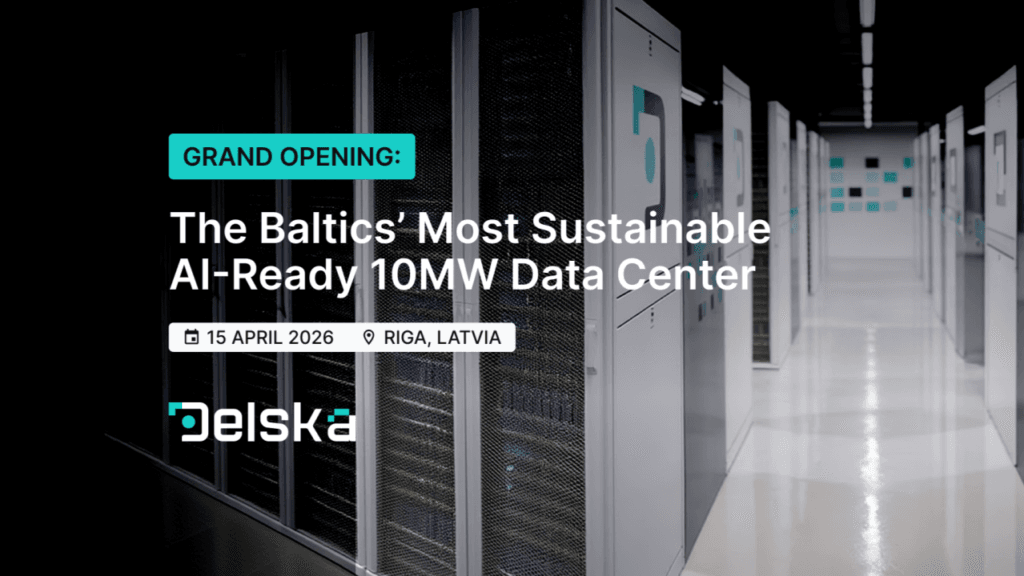
Delska EU North Riga LV DC1 - grand opening of the most sustainable AI-ready 10MW data center in the Baltics

This is a strategic milestone not only for Delska, but for the region.

To mark this launch, we are bringing together government representatives, global technology partners, and senior industry leaders to explore the future of compute, energy, and digital sovereignty.

đź“… April 15, 2026
📍 Riga, Latvia · In-person & Live Stream (RSVP required)
👉 Register: delska.com/lvdc1-launch-event

EU North Riga LV DC1 is built with a clear promise: infrastructure must scale with ambition.

  • 10 MW capacity, expandable to 30 MW on secured land with reserved power
  • Up to 250 kW per rack to support AI and HPC workloads at scale
  • Hybrid cooling architecture combining CoolWall air and liquid cooling
  • Powered by 100% renewable energy from Northern Europe
  • Designed to Tier III standards with 99.982% uptime
  • 400G connectivity backbone with low-latency access across Europe

This is not just an improved data center. It is a platform for next-generation compute deployment.

The opening will take place in two parts.

Private Opening Ceremony (invitation-only | live streamed) – featuring government leaders and strategic partners, setting the tone for the region’s digital future.

Executive Program (RSVP required) – with contributions from Dell Technologies, Veeam, 11Stream, and Delska, alongside:

  • Forward-looking perspectives on AI infrastructure and sovereign compute
  • Exclusive guided access to the facility
  • High-value networking with the regional and international tech ecosystem

We also have opened reservation access for organizations planning their next phase of infrastructure growth. If you cannot attend our launch event but would like to tour the facility on a private visit, please drop us a message – sales@delska.com.

👉 Pre-book your capacity: delska.com/data-centers/eu-north-riga-lv-dc1

Facilities like this are not built often. And access at this stage is even rarer.

If you are shaping infrastructure strategy for the coming years – this is where the conversation starts. Welcome!

#AIInfrastructure #DataCenters #SovereignCompute #GreenEnergy #Baltics #DigitalTransformation

https://www.linkedin.com/pulse/among-first-join-launch-next-generation-ai-data-center-gailitis-aroof

Related articles:

Digital Progress — Or Digital Dependence?

Key takeaways

  • Society increasingly depends on digital systems that must work 100% of the time – and centralization into a few hyperscale hubs makes failures more severe.
  • Data centers are now critical national infrastructure, as important as energy grids or transportation.
  • Regional and national data centers are a resilience strategy: digital services must survive even if larger global systems fail.
  • Digital infrastructure should be treated like energy security – a national priority, not a convenience.

The last decade of technological development sometimes feels like something straight out of science fiction – stories about powerful computers, intelligent machines, and systems quietly running the world behind the scenes.

Digital Progress — Or Digital Dependence?

Except reality isn’t nearly as glamorous.

I’ve always been a strong believer in technology and innovation. The digital economy has created extraordinary tools, services, and opportunities. But every now and then it’s worth pausing and asking a more uncomfortable question: are we actually becoming more vulnerable?

Despite all the technological progress, our society increasingly depends on systems that must work 100% of the time. When they do – everything feels seamless. But when they stop, the consequences can be far more severe than in the past.

One of the biggest risks is centralization.

Massive digital platforms and hyperscale infrastructure have concentrated enormous amounts of computing power and data into relatively few locations. At the same time, true privacy is slowly disappearing as our lives become fully digitized.

Data centers are no longer just IT infrastructure. They have become critical national infrastructure – as important as energy grids or transportation systems.

And this changes how we should think about them.

Instead of relying solely on a few global hyperscale hubs, countries should be investing in regional and national data centers that allow digital services to remain operational even if larger global systems fail.

Geographic distribution is no longer just an engineering preference – it is a resilience strategy.

From a geopolitical perspective, major digital infrastructure sites can quickly become primary targets during crises or conflicts. That means governments, companies, and infrastructure providers must invest more into redundancy, security, and distributed architecture.

Of course, this comes at a price.

More resilience means more infrastructure. More infrastructure means more protection. And ultimately, higher costs for digital services.

So the real question might not be whether technology is advancing – because it clearly is.

The real question is:

Are we building a stronger digital world, or simply a more fragile one that requires constant protection?

As a data center infrastructure provider, I strongly believe that regional digital infrastructure matters more than ever. Countries should not rely solely on a few global hyperscale centers. Digital independence requires local capacity, distributed architecture, and strategic resilience.

Maybe it’s time to start thinking about digital infrastructure the same way we think about energy security.

Not as a convenience.

But as a national priority.

And perhaps this is the question we should all start asking ourselves.

Subscribe & Share now if you are building, operating, and investing in the digital infrastructure of tomorrow.

#datacenters #digitalinfrastructure #cybersecurity #geopolitics #cloudcomputing #digitalsovreignty #datacenterindustry #criticalinfrastructure #techstrategy #futureoftechnology

https://www.linkedin.com/pulse/digital-progress-dependence-andris-gailitis-2oetf

Related articles:

Proudly powered by WordPress | Theme: Baskerville 2 by Anders Noren.

Up ↑