Europe Is Investing Heavily in AI Infrastructure – But There’s an Uncomfortable Gap We Don’t Talk About Enough

Key takeaways

  • EU funding for AI infrastructure (GPU clusters, supercomputers, data centers) is mostly CAPEX – the real long-term challenge is OPEX: electricity, cooling, engineers and upgrades.
  • Funding typically covers 2–5 year projects; afterwards either state budgets absorb the running costs or the infrastructure must become commercially viable.
  • Without sustainable operating models and an energy strategy, Europe risks building infrastructure that is underutilized, uncompetitive or financially unsustainable.
  • AI sovereignty requires funding outcomes, not just assets.

Across the EU, governments (with support from the European Commission) are funding GPU clusters, supercomputers, data centers and AI competence centers. This is great – and necessary. But most of this funding is CAPEX (buying and building the infrastructure).

EU funding for GPU clusters, supercomputers, data centers and AI competence centers

The real challenge? OPEX. Running AI at scale means:

  • ⚡ Massive electricity consumption
  • ❄️ Cooling and data center operations
  • 👨‍💻 Skilled engineers and ongoing maintenance
  • 🔄 Continuous hardware and software upgrades

And unlike the initial investment, these costs don’t go away.

In many cases, funding covers 2–5 year projects. After that:

  • Either the state budget absorbs the cost
  • Or the infrastructure must become commercially viable

That’s where things get tricky. Because AI today is not cheap:

  • Training models can cost millions
  • Even inference (serving models) requires constant GPU usage
  • Energy prices in Europe make everything more expensive

The result? We risk building impressive infrastructure that is underutilized, not globally competitive, or financially unsustainable long-term.

This isn’t a criticism – it’s a structural issue.

If Europe wants to be serious about AI sovereignty, we need to think beyond “building infrastructure” and address:

  • sustainable operating models
  • energy strategy for AI
  • public–private usage frameworks
  • long-term funding mechanisms

Otherwise, we’re funding assets – but not outcomes.

Curious to hear how others see this: Is Europe underestimating the cost of actually running AI?

#AI #Europe #DataCenters #HPC #Supercomputing #ArtificialIntelligence #DigitalInfrastructure #Energy #Innovation #TechPolicy #AIStrategy #capex #opex

https://www.linkedin.com/pulse/europe-investing-heavily-ai-infrastructure-theres-gap-gailitis-z4sbf

Related articles:
I Ran the Numbers: If You Filled a 1MW Data Center With iPhones – Here’s the Theoretical Compute Power You’d Get

Key takeaways

  • A 1MW data center could power about 250,000 iPhone 16 Pro Max units (~4W each under sustained load).
  • On paper that is ~1 ExaFLOP of FP32 GPU compute – exascale territory, rivaling the Frontier supercomputer.
  • Mobile chips are ~10x more power-efficient than data-center GPUs (~1 TFLOPS/W vs ~0.1 TFLOPS/W for an NVIDIA H100).
  • Reality check: thermal throttling, interconnect bandwidth and sustained-load limits make this a thought experiment, not a build plan.

Great thought experiment! Let me work through this. The newest iPhone is the iPhone 16 Pro Max (A18 Pro chip, released Sept 2024).

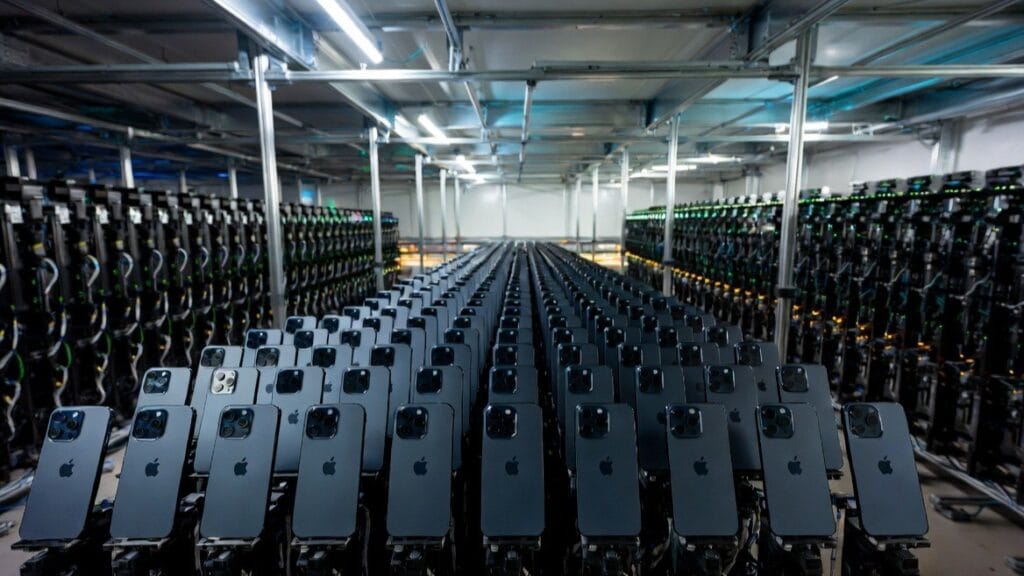
Server racks filled with iPhones in a 1MW data center thought experiment

How many iPhones? Under sustained heavy computational load, an iPhone 16 Pro Max draws roughly ~4 watts. That means 1,000,000W ÷ 4W = ~250,000 iPhones.

The A18 Pro chip has three compute engines.

GPU – ~4 TFLOPS (FP32) per device. 250,000 × 4 TFLOPS = 1 ExaFLOP – that’s exascale territory, matching the world’s most powerful supercomputers.

Neural Engine – 35 TOPS (INT8) per device. 250,000 × 35 TOPS = 8.75 PetaOPS for AI/ML inference workloads.

CPU – ~0.6 TFLOPS per device. 250,000 × 0.6 TFLOPS = ~150 PetaFLOPS.

Efficiency is actually impressive. The A18 Pro delivers roughly ~1 TFLOPS/W (GPU), while a data center-grade NVIDIA H100 GPU delivers ~0.1 TFLOPS/W (FP32). Mobile chips are extraordinarily power-efficient by comparison – they just can’t run continuously at peak without throttling.

Physical reality check: each iPhone 16 Pro Max is about 163 × 78 × 8.3 mm. 250,000 of them occupy roughly 26 cubic meters – filling only about 18 standard server racks physically, though cooling all those densely packed devices would be an engineering nightmare.

MetricValue
iPhones needed~250,000
GPU compute~1 ExaFLOP (FP32)
AI inference~8.75 PetaOPS (INT8)
Physical volume~26 m³ (~18 racks)
Cost (at ~$1,200/unit)~$300 million

The compute number is genuinely staggering – on paper it rivals Frontier, the world’s first exascale supercomputer – but of course real-world use would be limited by thermal throttling, interconnect bandwidth, and the fact that iPhones aren’t designed for sustained 100% load.

#DataCenters #AIInfrastructure #Compute #iPhone #HPC #EnergyEfficiency

https://www.linkedin.com/pulse/i-ran-numbers-you-filled-1mw-data-center-iphones-heres-gailitis-0rvtc

Related articles:

Proudly powered by WordPress | Theme: Baskerville 2 by Anders Noren.

Up ↑