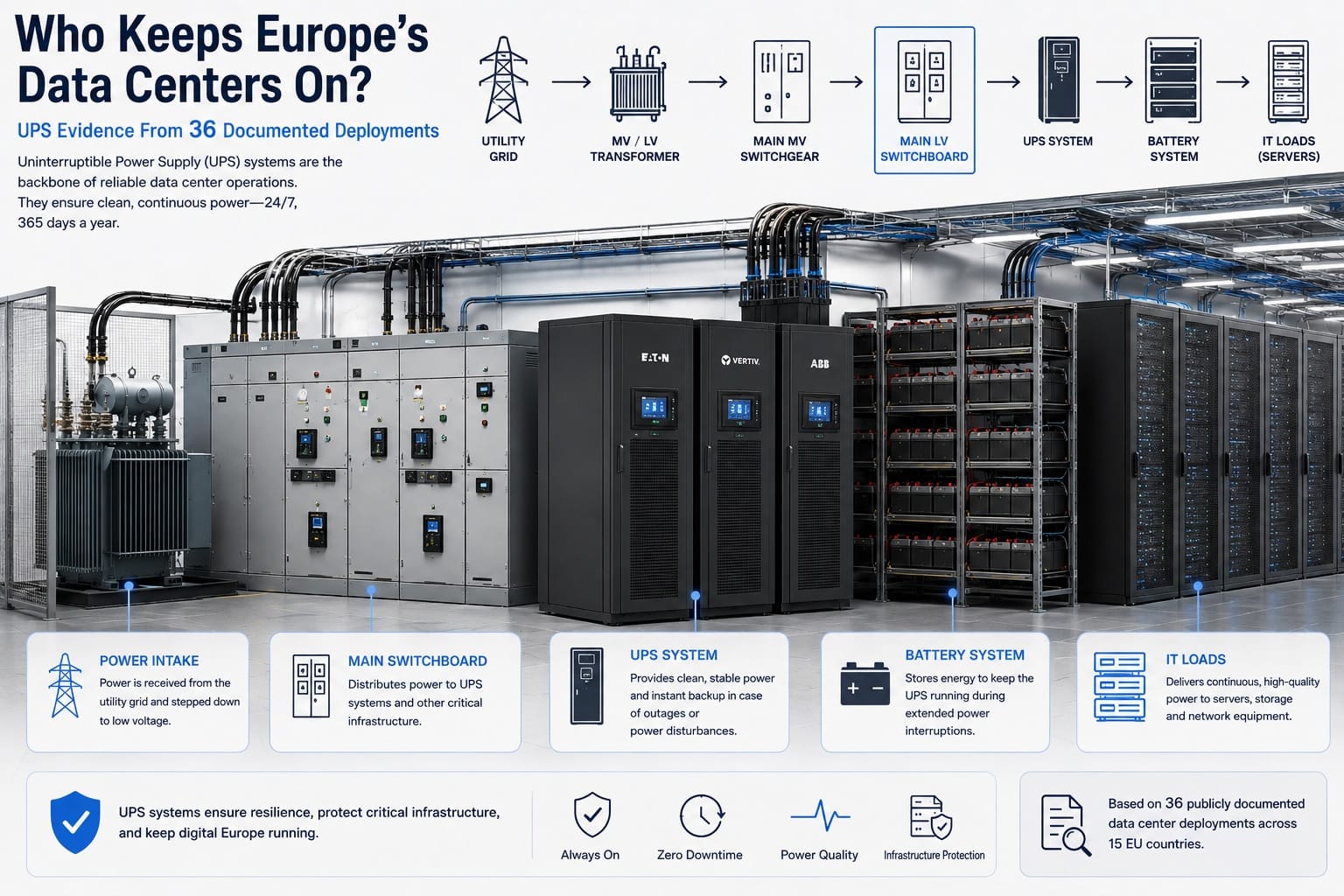
Key takeaways
- Vertiv (7) and Riello UPS (6) lead documented European 1–2 MW UPS deployments – Liebert EXL S1 and Multi Power are the workhorse families.
- Modular architecture is now the default: 15 of 36 documented European deployments. N+1 is the most common redundancy configuration (9 of 36).
- Lithium-ion appears in 5 documented deployments and is clearly displacing VRLA; static UPS dominates with only 2 dynamic (rotary) installations in the dataset.
- The evidence base: 364 raw signals filtered to 76 European ones (70 quality-verified), 60 documented deployments – 36 in Europe – across 17 countries and 32 manufacturers. Full sourced dataset in the attached report.
Everyone in this industry has opinions about UPS vendors. I wanted evidence instead. So we pulled 364 public signals – vendor case studies, press releases, project announcements – and filtered them down to 76 quality-verified European data points covering 36 documented deployments across 12 European countries. The question: who actually wins the 1–2 MW UPS deals in European data centers, and what gets deployed?
What the evidence shows.
| Manufacturer | Documented European deployments (1–2 MW) | Common families |
|---|---|---|
| Vertiv | 7 | Liebert EXL S1, APM2, Trinergy |
| Riello UPS | 6 | Multi Power, Master Plus |
| Kohler | 4 | PW 9250DPA, PowerWAVE 6000 |
| Borri | 3 | n/a |
| Schneider Electric | 2 | Galaxy VX, Galaxy NX |
| ABB | 2 | HiPerGuard (solid-state MV) |
| AEG Power Solutions | 2 | n/a |
| Hitec Power Protection | 2 | dynamic UPS |
| Others (Eaton, Delta, Centiel, Piller, Rolls-Royce…) | 1 each | mixed |
Vertiv remains the leader – 7 of 36 documented European deployments, from the University of Southampton (1.6 MW) to Conapto Stockholm North running on lithium-ion. But the surprise of the expanded dataset is Riello UPS at 6: quietly winning mid-size deals, especially in the UK, often replacing older systems with modular Multi Power units. Kohler’s 4 deployments tell a similar mid-market story. ABB plays a different game – fewer wins, but its HiPerGuard solid-state medium-voltage UPS at Ark Data Centres’ 25 MW Surrey campus points at where the high end is going.
Three patterns stand out. First, modularity has become the default – 15 of 36 deployments are explicitly modular, and it is not hard to see why: capacity that grows with the load beats a monolith you oversize on day one. Second, lithium-ion is displacing VRLA – 5 documented deployments already run Li-ion strings, and battery replacement projects consistently move in one direction. Third, static UPS overwhelmingly dominates: just 2 dynamic deployments in the entire dataset.
A note on method, because averages lie and vendor marketing lies more: every deployment in this dataset is tied to a public, verifiable source – the full list with deployment IDs, sources and confidence ratings is in the report below. Where the evidence was thin, the report says so. (And yes – the dataset skews toward the UK, home to 15 of the 36 deployments; documented evidence follows the markets that publish it.) This is not a market-share study; it is documented-deployment evidence, which is a different and, I would argue, more honest thing.
📄 Full research report (60 deployments, all sources): Download the PDF
Which UPS platform runs your critical load – and would you choose it again? 👇
Get the next research first
I publish one evidence-based research report most weeks – free, no paywall, full PDF attached. Subscribe to Cloud, Colo & Data Center Pro and the next one reaches you the day it is out.
#DataCenters #UPS #PowerInfrastructure #CriticalInfrastructure
Related articles: