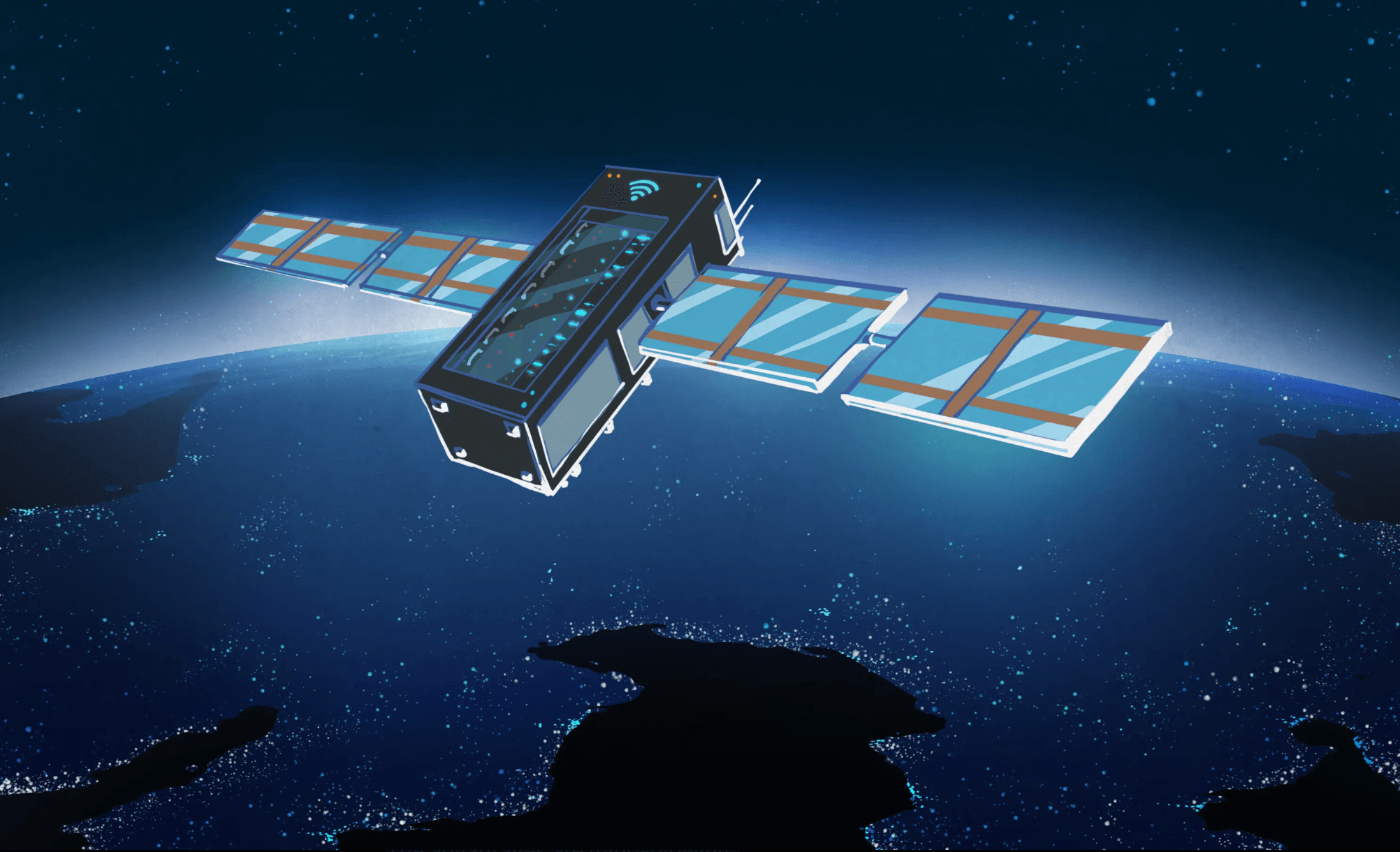
The future of AI computing is blasting off into orbit!

The current image has no alternative text. The file name is: Screenshot-2025-12-13-at-11.23.49.png

Key takeaways

  • In November 2025, Starcloud-1 trained AI models in orbit on an NVIDIA H100 – the first AI model training in space.
  • Orbital data centers promise near-constant solar power (up to 8x more effective than ground panels), zero water cooling and unlimited scalability.
  • Starcloud, Aetherflux, SpaceX, Blue Origin, Google and Europe’s ASCEND project are all racing toward orbital compute.
  • Main challenges – deployable radiators, radiation hardening, latency and launch costs – are falling fast.

As explosive AI growth pushes terrestrial data centers to their limits – devouring massive electricity, guzzling billions of gallons of water for cooling, facing land shortages, permitting delays, and grid overloads – a revolutionary alternative is emerging: orbital data centers.What once sounded like pure sci-fi is now reality. Just last month (November 2025), Nvidia-backed startup Starcloud (formerly Lumen Orbit) launched Starcloud-1, a compact satellite carrying a full Nvidia H100 GPU – 100x more powerful than any prior space compute hardware.And it worked spectacularly: In orbit, they successfully trained and ran multiple AI models, including Andrej Karpathy’s NanoGPT on the complete works of Shakespeare, and Google’s open-source Gemma LLM. This marks the first-ever AI model training in space, proving data-center-class GPUs can thrive in orbit.The advantages are mind-blowing:

  • Near-constant solar power: In optimized sun-synchronous orbits, satellites get up to 8x more effective energy than ground panels, with no night cycles or weather interruptions.
  • Zero water cooling: Waste heat radiates directly into the cold vacuum of space – no evaporation towers, no freshwater strain.
  • Unlimited scalability: No land acquisition, no local opposition, no grid upgrades needed.
  • Potentially 10x lower long-term costs: Even factoring launches, abundant clean energy and passive cooling slash operational expenses.
  • Sustainability boost: Orbital facilities could dramatically cut AI’s carbon footprint while preserving Earth’s precious resources.

The momentum is unstoppable. Major players are racing ahead:

  • Starcloud plans clusters with multiple H100s and Nvidia’s next-gen Blackwell GPUs in 2026–2027, targeting commercial workloads like satellite imagery inference for disaster response.
  • Aetherflux unveiled “Galactic Brain” – aiming for the first commercial orbital AI node in Q1 2027, leveraging space solar for unrestricted compute.
  • SpaceX (via Elon Musk) is adapting high-power Starlink V3 satellites for AI processing, with massive deployment potential via Starship.
  • Blue Origin has been quietly developing orbital data center tech for over a year.
  • Google’s Project Suncatcher explores solar-powered AI satellite constellations.
  • Axiom Space launching orbital data nodes soon.
  • Europe’s ASCEND project (led by Thales Alenia Space) confirmed feasibility for gigawatt-scale by mid-century.

Of course, real engineering challenges exist. Cooling dense racks demands large deployable radiators (governed by Stefan-Boltzmann radiation physics), radiation hardening for reliable operation, occasional latency for ground links, and upfront launch costs. But plummeting reusable rocket prices (thanks to Starship), innovative lightweight radiators, and proven demos like Starcloud-1 are rapidly closing those gaps.We’re witnessing the dawn of a new era: Abundant, green, scalable compute powering the AI revolution without burdening our planet. Orbital data centers aren’t just hype – they’re the sustainable path forward.What excites you most about this frontier? Will space host the world’s largest AI factories by 2040? Drop your thoughts below!

Subscribe & Share now if you are building, operating, and investing in the digital infrastructure of tomorrow.

#AI #SpaceTech #Innovation #ArtificialIntelligence #Sustainability #FutureOfComputing #OrbitalDataCenters #SpaceAI #AIRevolution #SustainableTech #TechInnovation #DeepTech

https://www.linkedin.com/pulse/future-ai-computing-blasting-off-orbit-andris-gailitis-c2ewf

Related articles:

Data Centres: From Tenants to Titans

Data Centres: From Tenants to Titans

Key takeaways

  • The balance of power has flipped: developers and operators, not hyperscalers, now hold the upper hand – the real scarcity is power and land.
  • US data centre rents rose from about $120/kW/month in 2021 to nearly $190 by 2024 – scarcity economics, not inflation.
  • 10-, 15- and 20-year contracts are the norm again, making data centres look and finance like traditional infrastructure.
  • The model is shifting from multi-tenant colocation to single-tenant mega-campuses of hundreds of megawatts.

Five years ago, few imagined that data centres — those humming, power-hungry fortresses of servers — would become one of the most coveted infrastructure assets on the planet.

But that’s exactly what has happened.

The balance of power has flipped. Once, hyperscalers like AWS, Google, and Microsoft dictated lease terms and pricing. Today, it’s the developers and operators holding the upper hand — because the real scarcity isn’t capital anymore. It’s power and land.


💡 The Golden Ticket

A leading infrastructure investor recently called power access “a golden ticket” — and it’s hard to disagree.

In the age of AI and hyperscale cloud growth, a secured grid connection is everything. You can raise billions and hire world-class engineers — but if you can’t plug into the grid, you can’t scale.

The numbers tell the story. In 2021, U.S. data centre rents averaged around $120 per kW per month. By 2024, that figure climbed over 50%, nearing $190 per kW. London saw similar jumps. This isn’t inflation — it’s scarcity economics.

Those who control powered land now hold the real bargaining power.


🧭 From Hyperscaler Leverage to Developer Control

For years, hyperscalers pushed for short 5- to 7-year contracts and flexible termination rights. They called the shots.

Not anymore.

Tight grid capacity and exploding AI demand have turned the tables. Tenants who once wanted short leases are now regretting it — there’s simply no capacity left, and renewals cost far more.

Today, 10-, 15-, and even 20-year contracts are the norm again. Banks and institutional lenders love it: predictable cash flows, long-dated contracts, and high-credit counterparties. Data centres are starting to look, feel, and finance like traditional infrastructure.


🏗️ From Colocation to Mega-Campuses

The model has evolved dramatically. What used to be multi-tenant colocation sites is becoming a network of massive, single-tenant campuses — hundreds of megawatts each — built around one hyperscaler.

That shift allows developers to recover rising capex costs tied to liquid cooling, AI training, and high-density workloads. Interestingly, many hyperscalers are now co-funding upgrades, treating them as tenant improvements, just like in commercial real estate.

It’s a more mature, symbiotic model — one that aligns incentives and strengthens partnerships.


🤝 Creative Structures and Shared Risk

Deal structures are also becoming more sophisticated.

When Meta financed its $26 billion data centre campus in Louisiana, the project reportedly included a “residual value guarantee.” In other words, if Meta exited early and the asset value dropped, investors would be compensated.

A few years ago, such clauses were rare. Now they’re becoming standard as both sides seek to balance long-term risk and reward.

Developers are also designing hybrid facilities — capable of switching between air and liquid cooling — and adopting flexible layouts that can evolve with technology. As Brookfield’s Sikander Rashid noted, “A chip’s useful life is about five years — your return on capital should match that.”


🏦 Core Capital Enters the Game

Not long ago, core and core-plus funds avoided data centres, seeing them as too technology-driven. That’s changing fast.

Brookfield, Arjun Infrastructure Partners, and Interogo recently invested in a €3.6 billion European data centre portfolio with 12-year average contracts and inflation-linked escalators — exactly the type of structure core infrastructure funds love.

One industry insider summed it up perfectly:

“If you’ve got powered land near population centres, your barrier to entry is the grid connection itself.”

In other words: the moat isn’t a brand or a logo — it’s megawatts.


⚙️ The Moat Built on Megawatts

Every road in this story leads back to power.

If forecasts hold true, most major data centre hubs will hit grid constraints within a decade. That physical bottleneck — not capital — will define value.

It’s why long-term leases are back. It’s why banks are lending more confidently. And it’s why investors view data centres as durable, inflation-protected infrastructure.

Operators like DigitalBridge are also moving to triple-net leases, where tenants manage their own power and cooling systems. That shift drives efficiency and attracts even more institutional capital.


🌍 The Future: Flexible, Long-Term, and Infra-Grade

So, are data centres infrastructure? The debate is over.

They’ve earned their place alongside utilities, ports, and energy assets — long-term contracts, critical grid dependence, and predictable returns.

But beyond the financials lies a bigger truth: the digital economy runs on electrons and geography. Whoever controls the megawatts controls the growth.

AI will only intensify this. The next generation of winners will be those who think like infrastructure investors but move like tech builders — fast, flexible, and focused on power resilience.

The moat is no longer theoretical. It’s physical. It’s grid-connected. And it’s here to stay.


✍️ The digital economy’s backbone isn’t code — it’s concrete, copper, and current. The investors who understand that first will shape the next decade of infrastructure.

Subscribe & Share now if you are building, operating, and investing in the digital infrastructure of tomorrow.

#DataCentres #InfrastructureInvesting #AIInfrastructure #DigitalTransformation #Sustainability #EnergyTransition #RealAssets #PrivateEquity #InfraFunds #Hyperscale #CloudComputing #PowerMarkets #GridCapacity #DataEconomy #LongTermCapital

https://www.linkedin.com/pulse/data-centres-from-tenants-titans-andris-gailitis-qjobf

Related articles:

Mind the Gap: Closing the Expectation Divide in Cloud & Data Center Services

Key takeaways

  • 99.95% uptime sounds excellent but still allows almost 4.5 hours of downtime a year – and customers only notice the failures.
  • Standard cloud and bare-metal contracts cover infrastructure access, not data protection: if backups are not in the contract, there is nothing to restore.
  • A backup stored on the same server is not a backup – real resilience requires offsite storage or separate physical infrastructure.

Global demand in cloud computing industry and data centers is growing faster than ever. There is an explosion of hyperscalers as well as AI workloads that provide unprecedented growth impetus; companies at every level depend on providers to maintain high-performance networks. Yet amid all its innovation and growth, though, one thing is unchanged: the difference between what service agreements promise and what customers expect.

Uptime: The One-Way Street of Gratitude

The majority of professional hosting and cloud agreements make an uptime priority minimum (generally 99.95% and up) for essential network and infrastructure. 99.95% is perfect for the average joe, but in practice it allows for almost 4½ hours of downtime a year. Here’s the paradox: if a provider provides flawless service for years, no one writes a thank-you note. The silence on success is just “business as usual.” But then for 5 minutes when a blip happens … still well under 99.95% of the promise … customer support lines light up and legal clauses get quoted back to the provider. It’s not the case of customers being ungrateful, the lesson is that reliability has been rendered invisible. Uptime is required, and any deviation, no matter how slight or contractually permissible, is regrettable.

Backups: The Unpaid — and Often Misplaced — Safety Net

And the other consistent rub is backup accountability. Many customers of the cloud and bare-metal world think data can be automatically backed up when it resides at a professional data center. In practice, much of the standard agreement does not provide protection for data but access to the essential infrastructure. When a virtual machine fails or a dedicated server’s disk dies, infrequent but inevitable events, customers without a backup plan often require that the provider “just recover it.” And unless backups were part of the contract (or bought as an add-on), the provider can’t magically restore lost data. Another common yet sometimes ignored rule: You don’t have backup and recovery if you don’t pay for them. Customers can and should be told and are supposed to be educated by providers, but the responsibility of protecting data integrity falls to the data owner.

Backups on the Same Server: A Concealable Catch

Even customers who maintain backups can fall into the trap of storing those backups on the same VM or dedicated server they’re trying to protect. When the underlying hardware fails, it means that both the live data and the “backup” could disappear in a single stroke. Real resilience is holding backups offsite or at least on different physical infrastructure — in another availability zone, on another storage platform or through a managed backup service. A backup that shares the same failure domain isn’t a backup at all; it is simply yet another copy waiting to fail.

Planned Maintenance: No Good Deed Goes Unpunished

Even infrastructure most reliably established requires care. Hardware firmware ought to be patched, network gadgets upgraded, and security equipment put to the latest security updates. Nearly every service agreement specifies the timing of scheduled maintenance windows, and providers generally work on those days in the dead of night with ample notice given. Yet maintenance notices regularly provoke resistance. Some customers need zero disruption at any cost, including when the work is needed to prevent future outages. Ironically, the clients who value stability can be hostile to the very processes needed to preserve it.

Bridging the Expectation Gap

So how do providers and customers come together in the middle?

Crystal-Clear SLAs

Service Level Agreements need to be written in plain language, specifying uptime objectives, response times, and — crucially — what is not included. Define roles for backups, recovery and data retention.

Proactive Education

Providers should communicate the reality of uptime %, needs for maintenance, and responsibilities for backups during the sales process, not after the fact.

Shared Responsibility Models

When you hear the term shared responsibility, public cloud behemoths such as AWS and Azure made it famous. The former way, (whether that be infrastructure-as-a-service (IaaS) or colocation), is that the provider maintains the platform, while the customer secures and backs up their data.

Celebrate Reliability

It might seem a little self-obsessed, but frequently appearing as reports of “X days of uninterrupted service” help remind subscribers of what they’re getting back — and can help soften feelings when an unavoidable event plays out.

Not a Transaction, a Partnership

A data-center / cloud agreement is a partnership in its simplest form. Providers agree to world-class uptime, redundancy, and security; clients agree to gauge the extent of those services and plan. And when each side sees the contract as a living document and not fine print, there’s less room for surprise and fewer panicking calls when the inevitable hiccup occurs.

Takeaway: That is, nothing about the world-defining infrastructure is ever “set and forget.” Transparency is the key to successful customer relationships: explicit SLAs, contracts of mutual responsibilities, and an understanding that when it comes to maintenance, backups (carried out in their own locations) and periodic downtime, the system is better for it. Finally, a strong provider is not someone who never does need to worry about a problem, but one who talks things over openly, keeps promises and works with customers to navigate the times when the lights go out.

#CloudComputing #DataCenters #SLA #Uptime #Downtime #CloudServices #Infrastructure #DevOps #ITOperations #ServiceLevelAgreement #HighAvailability #CloudReliability #CloudBackup #PlannedMaintenance #BusinessContinuity

https://www.linkedin.com/pulse/mind-gap-closing-expectation-divide-cloud-data-center-andris-gailitis-wo94f

Related articles:

When the Cable Snaps: Why Regional Compute Can’t Be an Afterthought

cable
compute
undersea

Key takeaways

  • Subsea cable cuts in the Baltic Sea (Nov 2024) and Red Sea (Sep 2025) showed how much digital life depends on a few physical chokepoints.
  • Rerouting works, but physics does not bend: latency jumps from 20 ms to 150 ms make latency-sensitive services unusable.
  • Regional compute is the antidote: continuity of performance, risk diversification and regulatory alignment.
  • Keeping capacity local is a resilience measure first, a compliance checkbox second.

It is a web of glass threads lying on the seabed. Twice, in starkly different seas, those threads were cut.

Two *subsea cables** in the Baltic Sea were cut within hours of one another in November 2024, cutting capacity across Finland, Lithuania, Sweden, and Germany.

In *September 2025**, multiple systems in the Red Sea, one of the world’s busiest internet corridors, were damaged and services were decimated across Europe, the Middle East, and Asia.

Each event had its own cause, but the net effect for users, enterprises, and cloud providers was the same: latency spikes, rerouting stress, an unpleasant lesson that our digital lives rely on a handful of physical chokepoints.

## The myth of infinite bandwidth

It is easy to assume “the cloud” will just absorb disruptions. Microsoft and AWS do have very good redundancy, and traffic was rerouted. But physics can’t be abstracted away:

*Latency increases** when traffic takes the bypass thousands of kilometers.

*Throughput decreases** when alternative routes inherit workloads.

*Resilience shrinks** when other cables in the same geography break down.

For latency-sensitive services — trading platforms, multiplayer gaming, video collaboration — the difference between 20 ms and 150 ms is the difference between usable and unusable. Because compliance-heavy workloads must reroute into areas with unknown jurisdictions, this carries very different risks of its own.

Regional compute is the antidote

The lesson is that if enterprises don’t want to expose themselves to chokepoints, regional compute capacity will have to be closer to both users and data sources. Regional doesn’t just mean “they’re all on the same continent.” And those operations must remain so they can continue if a submarine cable was cut and important international routes were taken offline. Regional compute operates in three aspects:

1. Continuity of performance – Maintain fast and stable mission-critical applications when cross-ocean fault paths are broken.

2. Risk diversification – Eliminate dependence on a single corridor — Red Sea, Baltic Sea, English Channel, etc.

3. Regulatory alignment – For some jurisdictions, including the EU, managing data within borders deals with sovereignty requirements as well.

## Europe as a case study—sovereignty through resilience

Europe’s movement for “digital sovereignty” (see NIS2, the EU Data Boundary, AWS’ European Sovereign Cloud…) is frequently presented in terms of compliance and control. But the cable incidents illustrate a more common principle: keeping capacity local is a resilience measure first, a regulatory checkbox second.

If you’re working inside the EU, sovereignty is one factor. If in Asia, the reasoning is similar — no need to rely on Red Sea transit. In North America, resilience might look like investing in a variety of east–west terrestrial routes to protect against coastal chokepoints.

A global problem with regional solutions

Route disruptions, by natural catastrophes, ship anchors, or even deliberate sabotage, have struck the Atlantic, Pacific, and Indian oceans. Every geography has its weak spots. That’s why international organizations are now more and more wondering: Where can we compute if the corridor collapses?

The answer frequently isn’t another distant hyperscale region. It’s:

*Regional data centers** embedded in terrestrial backbones.

*Local edge nodes** for caching and API traffic.

*Cross-border clusters** of real route diversity, not just carrier diversity.

## Building for the next cut

Here’s what CIOs, CTOs, and infrastructure leaders can do:

1. Map your exposure. Do you know which subsea corridors are mostly under your workload? Most organizations don’t. Ask for path transparency from your providers.

2. Design for “cable cut mode.” Envision what happens if the Baltic or Red Sea corridor goes dark. Test failover, measure latency, and revise the architecture accordingly.

3. Invest regionally, fail over regionally. Don’t just copy and paste data cross-sea. Build failover in your own core market when possible.

4. Contract for resilience. Diversity in routes, repair-time commitments, regional availability — build these into your SLAs.

5. Frame it as business continuity. This is not only a network ops situation, it’s a boardroom problem. One day of degraded service can exceed the cost of additional regional capacity.

Beyond sovereignty

Yes, sovereignty rules in Europe are a push factor. But sovereignty alone doesn’t explain why a fintech in Singapore, a SaaS in Toronto, or a hospital network in Nairobi would care about regional compute. They should care because cables are fragile, chokepoints are real, and physics doesn’t negotiate.

The bottom line

Last year’s cable cuts weren’t necessarily catastrophic. They were warnings. And the world’s dependence on a few narrow subsea corridors is increasing, not decreasing. As AI, streaming, and cloud adoption accelerate, the stakes rise.

Regional compute isn’t all about sovereignty. It’s about resilience. The organizations that internalize that lesson right now—before the next snap—will be the ones that stay fast, compliant, and reliable while others grind to a halt.

Subscribe & Share now if you are building, operating, and investing in the digital infrastructure of tomorrow.

#SubseaCables #CableCuts #DigitalResilience #RegionalCompute #DataCenters #EdgeComputing #NetworkResilience #CloudInfrastructure #DigitalSovereignty #Latency #BusinessContinuity #NIS2 #CloudComputing #InfrastructureSecurity #DataSovereignty #Connectivity #CriticalInfrastructure #CloudStrategy #TechLeadership #DigitalTransformation

https://www.linkedin.com/pulse/when-cable-snaps-why-regional-compute-cant-andris-gailitis-we9sf

Related articles:

Why Colocation and Private Infrastructure Are Making a Comeback—and Why Cloud Hype Is Wearing Thin

Colo-Coolocation

Key takeaways

  • 83% of enterprise CIOs planned to repatriate at least some workloads in 2024 (Barclays), up from 43% in 2020 – but only 8–9% plan full repatriation.
  • The drivers are unpredictable cloud billing, compliance burden, performance and control.
  • Colocation delivers predictable costs, data residency and direct hardware control.
  • The trend is not cloud vs colo – hybrid is the smarter default.

The Myth of Cloud-First—And the Reality of Repatriation.

For nearly a decade, businesses have been sold the idea of “cloud-first” as a golden ticket—unlimited scale, lower costs, effortless agility. But let’s be frank: that narrative wore thin a while ago. Now we’re seeing a smarter reality take shape—cloud repatriation: organizations moving workloads back from public cloud to colocation, private cloud, or on-prem infrastructure.

These Numbers Are Real—and Humbling

Still, let’s be clear: only about 8–9% of companies are planning a full repatriation. Most are just selectively bringing back specific workloads—not abandoning the cloud entirely. (https://newsletter.cote.io/p/that-which-never-moved-can-never)

Why Colo and On-Prem Are Winning Minds

Here’s where the ideology meets reality:

1. Predictable Cost Over Hyperscaler Surprise Billing

Public cloud is flexible—but also notorious for runaway bills. Unplanned spikes, data transfer fees, idle provisioning—it all adds up. Colo or owned servers require upfront investment, sure—but deliver stable, predictable costs. Barclays noted that spending on private cloud is leveling or even increasing in areas like storage and communications (https://www.channelnomics.com/insights/breaking-down-the-83-public-cloud-repatriation-number and https://8198920.fs1.hubspotusercontent-na1.net/hubfs/8198920/Barclays_Cio_Survey_2024-1.pdf).

2. Performance, Control, Sovereignty

Sensitive workloads—especially in finance, healthcare, or regulated industries—need tighter oversight. Colocation gives firms direct control over hardware, data residency, and networking. Latency-sensitive applications perform better when they’re not six hops away in someone else’s cloud (https://www.hcltech.com/blogs/the-rise-of-cloud-repatriation-is-the-cloud-losing-its-shine and https://thinkon.com/resources/the-cloud-repatriation-shift).

3. Hybrid Is the Smarter Default

The trend isn’t cloud vs. colo. It’s cloud + colo + private infrastructure—choosing the right tool for the workload. That’s been the path of Dropbox, 37signals, Ahrefs, Backblaze, and others (https://www.unbyte.de/en/2025/05/15/cloud-repatriation-2025-why-more-and-more-companies-are-going-back-to-their-own-data-center).

Case Studies That Talk Dollars

Let’s Be Brutally Honest: Public Cloud Isn’t a Unicorn Factory Anymore

Remember those “cloud-first unicorn” fantasies? They’re wearing off fast. Here’s the cold truth:

  • Cloud costs remain opaque and can bite hard.
  • Security controls and compliance on public clouds are increasingly murky and expensive.
  • Vendor lock-in and lack of control can stifle agility, not enhance it.
  • Real innovation—especially at scale—often comes from owning your infrastructure, not renting someone else’s.

What’s Your Infrastructure Strategy, Really?

Here’s a practical playbook:

  1. Question the hype. Challenge claims about mythical cloud savings.
  2. Audit actual workloads. Which ones are predictable? Latency-sensitive? Sensitive data?
  3. Favor colo for the dependable, crucial, predictable. Use public cloud for seasonal, experimental, or bursty workloads.
  4. Lock down governance. Owning hardware helps you own data control.
  5. Watch your margins. Infra doesn’t have to be sexy—it just needs to pay off.

The Final Thought

Cloud repatriation is real—and overdue. And that’s not a sign of retreat; it’s a sign of maturity. Forward-thinking companies are ditching dreamy catchphrases like “cloud unicorns” and opting for rational hybrids—colocation, private infrastructure, and only selective cloud. It may not be glamorous, but it’s strategic, sovereign, and smart.

Subscribe & Share now if you are building, operating, and investing in the digital infrastructure of tomorrow.

#CloudRepatriation #HybridCloud #DataCenters #Colocation #PrivateCloud #CloudStrategy #CloudCosts #Infrastructure #ITStrategy #DigitalSovereignty #CloudEconomics #ServerRentals #EdgeComputing #TechLeadership #CloudMigration #OnPrem #MultiCloud #ITInfrastructure #CloudSecurity #CloudReality

https://www.linkedin.com/pulse/why-colocation-private-infrastructure-making-cloud-hype-gailitis-bcguf

Related articles:

AI Inside AI: How Data Centers Can Use AI to Run AI Workloads Better

AI Inside AI: How Data Centers Can Use AI to Run AI Workloads Better

Key takeaways

  • AI can run the AI data center: instant temperature and airflow forecasting, predictive maintenance from sensor data, and energy-aware scheduling of training jobs.
  • Real-time monitoring of PUE, WUE and carbon intensity turns efficiency into an operational discipline.
  • AI also covers security anomaly detection, GPU health forecasting, incident “fire drills” and automated compliance reporting.
  • If you host AI workloads, your operations should be AI-driven too – a necessity, not a choice.

This is a high-stakes AI workload host challenge—the machinery has a dense GPU cluster but also hard-to-predict demand and extreme cooling demands. However, the same technology pushing this sort of workload in the future will also help the center run more smoothly, safely, and environmentally friendly.

How to use AI to manage the AI data center in 10 steps:

1. AI models instantly forecast temperature changes. These models can render instant forecasts of airflow patterns to compensate for hot areas by, for example, fitting a contained LC unit that translates recycling air with an independent refrigeration system into cooling power delivered directly on top of electronic parts needing it.

2. Use vibration, power draw, and sensor data from chillers, UPSes, and PDUs to target those pieces of equipment that are likely to break long before they do.

3. Energy-Aware Scheduler for AI Training Jobs. Run the workloads at times when there is a cleaner grid and send those on out to areas with more wind turbines.

4. Optimizing Scheduling of AI Workloads. Spreading GPU-heavy jobs across clusters in order to even out the load saves one region from overloading while others wait.

5. Real-time Adaptive Efficiency Monitoring constantly observes PUE, WUE, and Carbon intensity with real-time recommendations to operations—if everything looks efficient, let’s not get hasty and take a risk that could put us out of business.

6. Building-Intelligence Video-Surveillance Security Anomaly Detection. Scans access logs, security cameras, and network traffic for signs of someone trying to break in.

7. Feature: GPU/TPU Hardware-Health Forecasting. Identifies symptoms of degeneration—error rates increasing, components overheating or running slow—for replacement before training jobs fail entirely.

8. Incident simulation and response planning. Running digital “fire drills” to see what the plant would do when: cooling failed, power was lost, or if there were a cyber attack.

9. Real-time automated compliance reporting ISO, SOC, etc. Using the operational logs of the facility to onboard customers faster. Pulls from system/operational logs for audit reports on-demand (reliable and consistent & audit-ready).

10. Automated GPU node on/off with Intelligent Resource Scaling. It won’t turn on GPU nodes just because you’re using them, it will also try to keep energy costs down through effective management.

In the end, if you have an AI host, then your business should be AI-driven too. It is not a matter of choice, but of necessity in order to deal with the scale and complexity of these modern AI workloads, that we begin using machine intelligence for both heating control and cooling spot-by-spot because it simply has become routine everywhere else.

Subscribe & Share now if you are building, operating, and investing in the digital infrastructure of tomorrow.

#DataCenter #CloudComputing #HostingSolutions #GreenTech #SustainableHosting #AI #ArtificialIntelligence #EcoFriendly #RenewableEnergy #DataStorage #TechForGood #SmartInfrastructure #DigitalTransformation #CloudHosting #GreenDataCenter #EnergyEfficiency #FutureOfTech #Innovation #TechSustainability #AIForGood

https://www.linkedin.com/pulse/ai-inside-how-data-centers-can-use-run-workloads-better-gailitis-1hjzf

Related articles:

Beyond Uptime

Beyond uptime - liquid cooling hardware in an AI-ready data center

Key takeaways

  • AI training racks pull 30–80 kW – 5–10x more than the 3–10 kW enterprise racks most pre-2018 facilities were built for.
  • GPU clusters can jump from idle to full draw in a second, stressing both power and cooling systems.
  • Legacy air cooling, UPS and switchgear face hard physical limits with 40+ kW racks.
  • The survivors will not be the newest buildings but the best retrofits: hybrid cooling, modular AI pods and targeted power upgrades.

Can Yesterday’s Data Centers Handle Tomorrow’s AI?

Industry-wide, thousands of megawatts are hostage to data centers that were limiting AI lifecycles before this technology boom. Some are already constructed, some in the middle of construction — all tailored to dirty workloads that still, for most people (until recently), would have looked nothing like today’s GPU-rich cluster.

With the prevalence of high-density AI workloads, hybrid cooling requirements, and one-minute deployment cycles to keep data centers competitive in an AI-driven world, the question becomes extremely relevant.

1. The AI Workload Shift

Artificial Intelligence is changing the rules of infrastructure.

  • At the bottom, we have training clusters — One AI training rack can pull 30–80 KW, which is 5x-10x higher than a traditional enterprise rack.
  • Inference workloads — Not so centralized, but still push physical cooling and networking beyond the realm of legacy architectures.
  • Dynamic loads — GPU clusters can go from idle to full draw in a second, which both stresses power and cooling systems.

For many facilities, this isn’t a “nice to have” upgrade — it’s an existential need to adapt and compete with the next generation of patrons.

2. Limits of Traditional Design

The majority of pre-AI data centers (ones built before 2018, if we were to define it very strictly) were constructed for racks in the 3–10 kW per rack range cooled by air.

  • Cooling: CRAC/CRAH units and hot aisle containment — were not designed for 40+ kW racks.
  • Change-out of UPS, PDUs, and Switchgear sized for lower densities [Selective or Full Replacement]
  • Some unique to the application — 5 kW racks respond better to larger f/r ratios, the circumstances leading up to a raised floor collapse or a rack tipping over because it was back heavy than others (aka top or bottom heavy).

Here though, some facilities are really going to be able to adapt while others may hit hard physical limits that will limit their AI-readiness.

3. Adaptation Strategies

The operators who survive won’t necessarily be the ones with the newest buildings — but those whose retrofits well.

  • A combination of air cooling (for standard workloads) with direct-to-chip liquid cooling or rear-door heat exchangers for AI racks as hybrid cooling models.
  • Modular AI Temps — High-density AI in the rest of the data center once special halls or pods are converted to deter high heat output AI.
  • Point solutions for Power — Enhancing few electric runs to sustain AI loads without turning the facility upside down.
  • Network design — High throughput but best in class low latency interconnects between GPU nodes guaranteeing optimal operation of the cluster.

And Hybridization escapes the ‘all-or-nothing’ syndrome, enabling facilities to tap into AI demand but not at the expense of their current customer base.

4. The Retrofit ROI Question

As a result, not all data centers would — or should — be AI ready.

Retrofitting high-density zones is capex-heavy:

  • That should be up in the millions when it comes to power upgrades.
  • Installing liquid cooling systems requires mechanical, plumbing, and floorplan changes.
  • Network upgrades add further cost.

Workload demand, competitive landscape, and the lifespan of the existing facility constitute your decision point.

In those situations, it may be more cost-effective to create a greenfield site in close proximity to the existing building and visit for scheduled maintenance only rather than investing capital in deep retrofits.

5. The Strategic Outlook

This is the dawn of AI infrastructure expansion. Three likely scenarios are emerging:

  • Traditional racks blended with AI-ready pods: Dual-use facilities
  • Artificial intelligence-specific buildings with layer upon layer of extreme density and liquid cooling built from scratch.
  • AI/ML ‘clusters — rather than metro density, these will concentrate compute closer to large power-rich, low-latency markets.

The AI era doesn’t plan for the next 20-year build cycle. Those operators who change now with clear retrofit strategies in place will secure the first-mover advantage on the next wave of customers.

Closing Thoughts

Actually, running AI is not just “another workload.” It is a completely different thermal, power, and interconnect problem. The form and function of yesterday can meet the AI needs of tomorrow — but only if operators take a targeted, rational, and accelerated approach to redesign.

Subscribe & Share now if you are building, operating, and investing in the digital infrastructure of tomorrow.

AI #DataCenters #AIInfrastructure #HighDensityComputing #HybridCooling #LiquidCooling #GPUClusters #CloudComputing #DataCenterRetrofit #EdgeComputing #DigitalInfrastructure #Colocation #AIThermalManagement #PowerUpgrades #NextGenDataCenters

https://www.linkedin.com/pulse/beyond-uptime-andris-gailitis-hiovf

Related articles:

Proudly powered by WordPress | Theme: Baskerville 2 by Anders Noren.

Up ↑