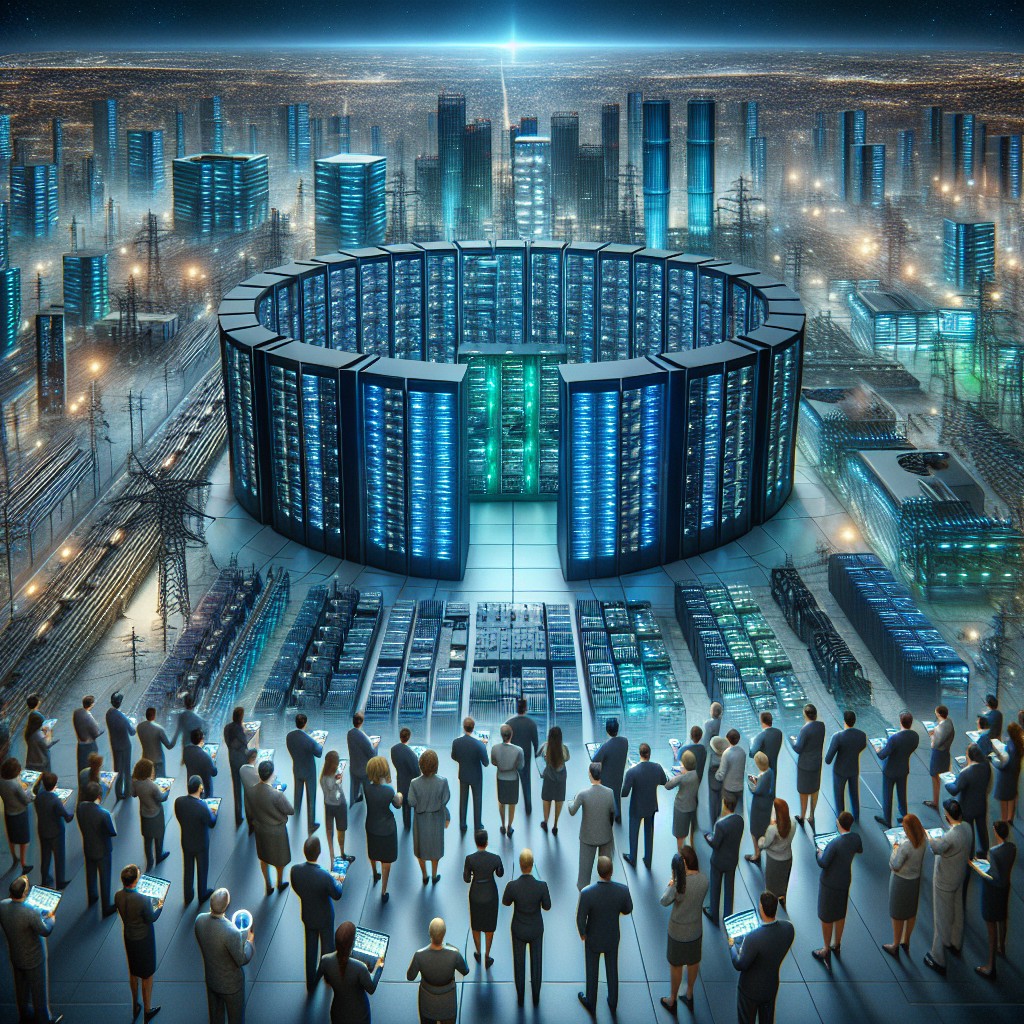
Digital Progress — Or Digital Dependence?

The last decade of technological development sometimes feels like something straight out of science fiction – stories about powerful computers, intelligent machines, and systems quietly running the world behind the scenes.

Except reality isn’t nearly as glamorous.

I’ve always been a strong believer in technology and innovation. The digital economy has created extraordinary tools, services, and opportunities. But every now and then it’s worth pausing and asking a more uncomfortable question: are we actually becoming more vulnerable?

Despite all the technological progress, our society increasingly depends on systems that must work 100% of the time. When they do – everything feels seamless. But when they stop, the consequences can be far more severe than in the past.

One of the biggest risks is centralization.

Massive digital platforms and hyperscale infrastructure have concentrated enormous amounts of computing power and data into relatively few locations. At the same time, true privacy is slowly disappearing as our lives become fully digitized.

Data centers are no longer just IT infrastructure. They have become critical national infrastructure – as important as energy grids or transportation systems.

And this changes how we should think about them.

Instead of relying solely on a few global hyperscale hubs, countries should be investing in regional and national data centers that allow digital services to remain operational even if larger global systems fail.

Geographic distribution is no longer just an engineering preference – it is a resilience strategy.

From a geopolitical perspective, major digital infrastructure sites can quickly become primary targets during crises or conflicts. That means governments, companies, and infrastructure providers must invest more into redundancy, security, and distributed architecture.

Of course, this comes at a price.

More resilience means more infrastructure. More infrastructure means more protection. And ultimately, higher costs for digital services.

So the real question might not be whether technology is advancing – because it clearly is.

The real question is:

Are we building a stronger digital world, or simply a more fragile one that requires constant protection?

As a data center infrastructure provider, I strongly believe that regional digital infrastructure matters more than ever. Countries should not rely solely on a few global hyperscale centers. Digital independence requires local capacity, distributed architecture, and strategic resilience.

Maybe it’s time to start thinking about digital infrastructure the same way we think about energy security.

Not as a convenience.

But as a national priority.

And perhaps this is the question we should all start asking ourselves.

Subscribe & Share now if you are building, operating, and investing in the digital infrastructure of tomorrow.

#datacenters #digitalinfrastructure #cybersecurity #geopolitics #cloudcomputing #digitalsovreignty #datacenterindustry #criticalinfrastructure #techstrategy #futureoftechnology

https://www.linkedin.com/pulse/digital-progress-dependence-andris-gailitis-2oetf

The EU Compliance Machine: Who Does It Really Protect?

It is obvious to everyone that digital security and data protection are important, and few understand this better than the operators and infrastructure providers who work with these systems every day. But there is a growing feeling that the EU, through its regulations, is actively pushing businesses away.

The current image has no alternative text. The file name is: 5064137f-f9d6-40f7-b54a-dba64998b1db.png

The sheer madness surrounding GDPR, NIS2, DORA, country-specific cybersecurity laws, data-center regulations, and multiple national data protection authorities has created an environment of extreme bureaucracy. In practice, this translates into enormous time consumption, excessive costs, and the need to maintain permanent in-house staff such as lawyers, GDPR specialists, CISOs, compliance managers, and external consultants. The whole system is designed so that the focus is not on the outcome itself, but on the procedures used to achieve it.

What makes the situation even worse is that many requirements which, at the EU level, are presented as high-level guidelines or relatively light recommendations are later transformed by national legislators into rigid, over-enforced laws. These laws are implemented in a way that effectively forces companies either to bluff their compliance on paper or, if they attempt to fully comply in practice, to become slow, inefficient, and ultimately uncompetitive.

At times, it almost feels as if this regulatory framework is being designed primarily for military use cases and for businesses directly serving defense and critical state infrastructure-where such levels of control and rigidity may be justified. For most commercial businesses-and especially for SMBs—this regulatory model is not just disproportionate, it is fatal.

What we are witnessing is an artificially inflated compliance industry that absorbs resources without creating real business value. Instead of enabling innovation, these regulations slow companies down, reduce agility, and significantly hurt operational efficiency.

On top of that, an unreasonable amount of internal time is consumed by staff who must continuously fill out endless questionnaires, assessments, and compliance forms. These are brought in by almost every third customer, often with little or no connection to real operational risks or practical reality. Entire teams are forced to focus on paperwork rather than actual delivery, engineering, or customer value.

At times, it even becomes necessary to carefully evaluate which clients you want to work with and which you don’t-simply because some customers introduce a disproportionate regulatory burden and legal exposure.

Take colocation providers, hardware renting companies, or cloud pure infrastructure providers as an example. Even when the provider has no access to customer data, they are still required to sign countless declarations, appendices, amendments, and regulatory commitments-often assuming responsibility for matters that are only marginally related to their actual services.

This topic alone could easily fill an entire book.

Subscribe & Share now if you are building, operating, and investing in the digital infrastructure of tomorrow.

#Cybersecurity #DataProtection #GDPR #NIS2 #DORA #EURegulation #ComplianceOverload #DigitalInfrastructure #SMBs #EuropeanBusiness #TechPolicy #OperationalReality

https://www.linkedin.com/pulse/eu-compliance-machine-who-does-really-protect-andris-gailitis-9yybf

The future of AI computing is blasting off into orbit!

As explosive AI growth pushes terrestrial data centers to their limits – devouring massive electricity, guzzling billions of gallons of water for cooling, facing land shortages, permitting delays, and grid overloads – a revolutionary alternative is emerging: orbital data centers.What once sounded like pure sci-fi is now reality. Just last month (November 2025), Nvidia-backed startup Starcloud (formerly Lumen Orbit) launched Starcloud-1, a compact satellite carrying a full Nvidia H100 GPU – 100x more powerful than any prior space compute hardware.And it worked spectacularly: In orbit, they successfully trained and ran multiple AI models, including Andrej Karpathy’s NanoGPT on the complete works of Shakespeare, and Google’s open-source Gemma LLM. This marks the first-ever AI model training in space, proving data-center-class GPUs can thrive in orbit.The advantages are mind-blowing:

The current image has no alternative text. The file name is: Screenshot-2025-12-13-at-11.23.49.png
  • Near-constant solar power: In optimized sun-synchronous orbits, satellites get up to 8x more effective energy than ground panels, with no night cycles or weather interruptions.
  • Zero water cooling: Waste heat radiates directly into the cold vacuum of space – no evaporation towers, no freshwater strain.
  • Unlimited scalability: No land acquisition, no local opposition, no grid upgrades needed.
  • Potentially 10x lower long-term costs: Even factoring launches, abundant clean energy and passive cooling slash operational expenses.
  • Sustainability boost: Orbital facilities could dramatically cut AI’s carbon footprint while preserving Earth’s precious resources.

The momentum is unstoppable. Major players are racing ahead:

  • Starcloud plans clusters with multiple H100s and Nvidia’s next-gen Blackwell GPUs in 2026–2027, targeting commercial workloads like satellite imagery inference for disaster response.
  • Aetherflux unveiled “Galactic Brain” – aiming for the first commercial orbital AI node in Q1 2027, leveraging space solar for unrestricted compute.
  • SpaceX (via Elon Musk) is adapting high-power Starlink V3 satellites for AI processing, with massive deployment potential via Starship.
  • Blue Origin has been quietly developing orbital data center tech for over a year.
  • Google’s Project Suncatcher explores solar-powered AI satellite constellations.
  • Axiom Space launching orbital data nodes soon.
  • Europe’s ASCEND project (led by Thales Alenia Space) confirmed feasibility for gigawatt-scale by mid-century.

Of course, real engineering challenges exist. Cooling dense racks demands large deployable radiators (governed by Stefan-Boltzmann radiation physics), radiation hardening for reliable operation, occasional latency for ground links, and upfront launch costs. But plummeting reusable rocket prices (thanks to Starship), innovative lightweight radiators, and proven demos like Starcloud-1 are rapidly closing those gaps.We’re witnessing the dawn of a new era: Abundant, green, scalable compute powering the AI revolution without burdening our planet. Orbital data centers aren’t just hype – they’re the sustainable path forward.What excites you most about this frontier? Will space host the world’s largest AI factories by 2040? Drop your thoughts below!

Subscribe & Share now if you are building, operating, and investing in the digital infrastructure of tomorrow.

#AI #SpaceTech #Innovation #ArtificialIntelligence #Sustainability #FutureOfComputing #OrbitalDataCenters #SpaceAI #AIRevolution #SustainableTech #TechInnovation #DeepTech

https://www.linkedin.com/pulse/future-ai-computing-blasting-off-orbit-andris-gailitis-c2ewf

Data Centres: From Tenants to Titans

Five years ago, few imagined that data centres — those humming, power-hungry fortresses of servers — would become one of the most coveted infrastructure assets on the planet.

But that’s exactly what has happened.

The balance of power has flipped. Once, hyperscalers like AWS, Google, and Microsoft dictated lease terms and pricing. Today, it’s the developers and operators holding the upper hand — because the real scarcity isn’t capital anymore. It’s power and land.


💡 The Golden Ticket

A leading infrastructure investor recently called power access “a golden ticket” — and it’s hard to disagree.

In the age of AI and hyperscale cloud growth, a secured grid connection is everything. You can raise billions and hire world-class engineers — but if you can’t plug into the grid, you can’t scale.

The numbers tell the story. In 2021, U.S. data centre rents averaged around $120 per kW per month. By 2024, that figure climbed over 50%, nearing $190 per kW. London saw similar jumps. This isn’t inflation — it’s scarcity economics.

Those who control powered land now hold the real bargaining power.


🧭 From Hyperscaler Leverage to Developer Control

For years, hyperscalers pushed for short 5- to 7-year contracts and flexible termination rights. They called the shots.

Not anymore.

Tight grid capacity and exploding AI demand have turned the tables. Tenants who once wanted short leases are now regretting it — there’s simply no capacity left, and renewals cost far more.

Today, 10-, 15-, and even 20-year contracts are the norm again. Banks and institutional lenders love it: predictable cash flows, long-dated contracts, and high-credit counterparties. Data centres are starting to look, feel, and finance like traditional infrastructure.


🏗️ From Colocation to Mega-Campuses

The model has evolved dramatically. What used to be multi-tenant colocation sites is becoming a network of massive, single-tenant campuses — hundreds of megawatts each — built around one hyperscaler.

That shift allows developers to recover rising capex costs tied to liquid cooling, AI training, and high-density workloads. Interestingly, many hyperscalers are now co-funding upgrades, treating them as tenant improvements, just like in commercial real estate.

It’s a more mature, symbiotic model — one that aligns incentives and strengthens partnerships.


🤝 Creative Structures and Shared Risk

Deal structures are also becoming more sophisticated.

When Meta financed its $26 billion data centre campus in Louisiana, the project reportedly included a “residual value guarantee.” In other words, if Meta exited early and the asset value dropped, investors would be compensated.

A few years ago, such clauses were rare. Now they’re becoming standard as both sides seek to balance long-term risk and reward.

Developers are also designing hybrid facilities — capable of switching between air and liquid cooling — and adopting flexible layouts that can evolve with technology. As Brookfield’s Sikander Rashid noted, “A chip’s useful life is about five years — your return on capital should match that.”


🏦 Core Capital Enters the Game

Not long ago, core and core-plus funds avoided data centres, seeing them as too technology-driven. That’s changing fast.

Brookfield, Arjun Infrastructure Partners, and Interogo recently invested in a €3.6 billion European data centre portfolio with 12-year average contracts and inflation-linked escalators — exactly the type of structure core infrastructure funds love.

One industry insider summed it up perfectly:

“If you’ve got powered land near population centres, your barrier to entry is the grid connection itself.”

In other words: the moat isn’t a brand or a logo — it’s megawatts.


⚙️ The Moat Built on Megawatts

Every road in this story leads back to power.

If forecasts hold true, most major data centre hubs will hit grid constraints within a decade. That physical bottleneck — not capital — will define value.

It’s why long-term leases are back. It’s why banks are lending more confidently. And it’s why investors view data centres as durable, inflation-protected infrastructure.

Operators like DigitalBridge are also moving to triple-net leases, where tenants manage their own power and cooling systems. That shift drives efficiency and attracts even more institutional capital.


🌍 The Future: Flexible, Long-Term, and Infra-Grade

So, are data centres infrastructure? The debate is over.

They’ve earned their place alongside utilities, ports, and energy assets — long-term contracts, critical grid dependence, and predictable returns.

But beyond the financials lies a bigger truth: the digital economy runs on electrons and geography. Whoever controls the megawatts controls the growth.

AI will only intensify this. The next generation of winners will be those who think like infrastructure investors but move like tech builders — fast, flexible, and focused on power resilience.

The moat is no longer theoretical. It’s physical. It’s grid-connected. And it’s here to stay.


✍️ The digital economy’s backbone isn’t code — it’s concrete, copper, and current. The investors who understand that first will shape the next decade of infrastructure.

Subscribe & Share now if you are building, operating, and investing in the digital infrastructure of tomorrow.

#DataCentres #InfrastructureInvesting #AIInfrastructure #DigitalTransformation #Sustainability #EnergyTransition #RealAssets #PrivateEquity #InfraFunds #Hyperscale #CloudComputing #PowerMarkets #GridCapacity #DataEconomy #LongTermCapital

https://www.linkedin.com/pulse/data-centres-from-tenants-titans-andris-gailitis-qjobf

The Elite Cycle

1. What is “elite overproduction” or “elite inflation”?

The term elite overproduction (sometimes called elite inflation) describes a situation where society produces more people aspiring to elite status — for example, educated and ambitious individuals seeking high-level positions or influence — than there are actual openings within the elite itself (in politics, business, public administration, etc.).

The “elite” refers to those who hold or strive to hold positions of power and influence — political, economic, ideological, or intellectual.

When there are too many educated and ambitious people, and not all can be “absorbed” into the elite, a layer of frustrated and excluded aspirants emerges. In structural-demographic theory (SDT), this is seen as one of the main drivers of social instability.


2. Why can having “too many elites” create instability?

Competition within the elite The more people compete for a limited number of top positions, the fiercer the rivalry becomes among elites themselves — leading to divisions and internal conflicts.

Frustrated “failed” elite aspirants Those who expected to gain power or status but were shut out often become bitter and may join radical or anti-establishment movements.

Erosion of legitimacy When many people see that the path upward is blocked while the existing elite clings to its privileges, trust in the system declines.

Ideological polarization As elite groups compete for support, they may adopt increasingly extreme or opposing positions, further dividing society.

Administrative overload Too many elite aspirants can put pressure on state resources — more people demanding jobs, subsidies, or privileges — which undermines fiscal stability and governance quality.


3. Strengths and criticisms

Strengths

  • Explains a visible phenomenon: many educated, ambitious people feeling “stuck.”
  • Highlights that crises can be caused not only by the masses but also by elite rivalries themselves.
  • Supported by historical parallels — such as the late Roman Empire, Chinese dynastic collapses, or European crises.

Weaknesses

  • It’s hard to precisely define who counts as “elite” and how much “overproduction” there really is.
  • The theory can sound overly deterministic — as if decline is inevitable and cyclical.
  • Other scholars emphasize different causes: inequality, the shrinking middle class, institutional decay, or media polarization.
  • Not every case of elite overproduction leads to crisis — strong institutions can sometimes absorb and adapt.

4. Does this apply to today’s Western world ?

We can see similar patterns: many university graduates with high ambitions unable to find jobs matching their skills. These “failed elite aspirants” may become critics of the political system, supporters of radicals, or simply a destabilizing force.

The key question is whether this phenomenon is widespread enough in Latvia and the West to become a systemic problem. It seems to grow dangerous when combined with other factors — economic inequality, fiscal strain, and public distrust in institutions.

Subscribe & Share now if you are building, operating, and investing in the digital infrastructure of tomorrow.

#Leadership #Society #Economics #Politics #SocialTrends #EliteOverproduction #FutureOfWork #Inequality #Latvia #CrowdedAtTheTop

https://www.linkedin.com/pulse/elite-cycle-andris-gailitis-pli0f

Proudly powered by WordPress | Theme: Baskerville 2 by Anders Noren.

Up ↑