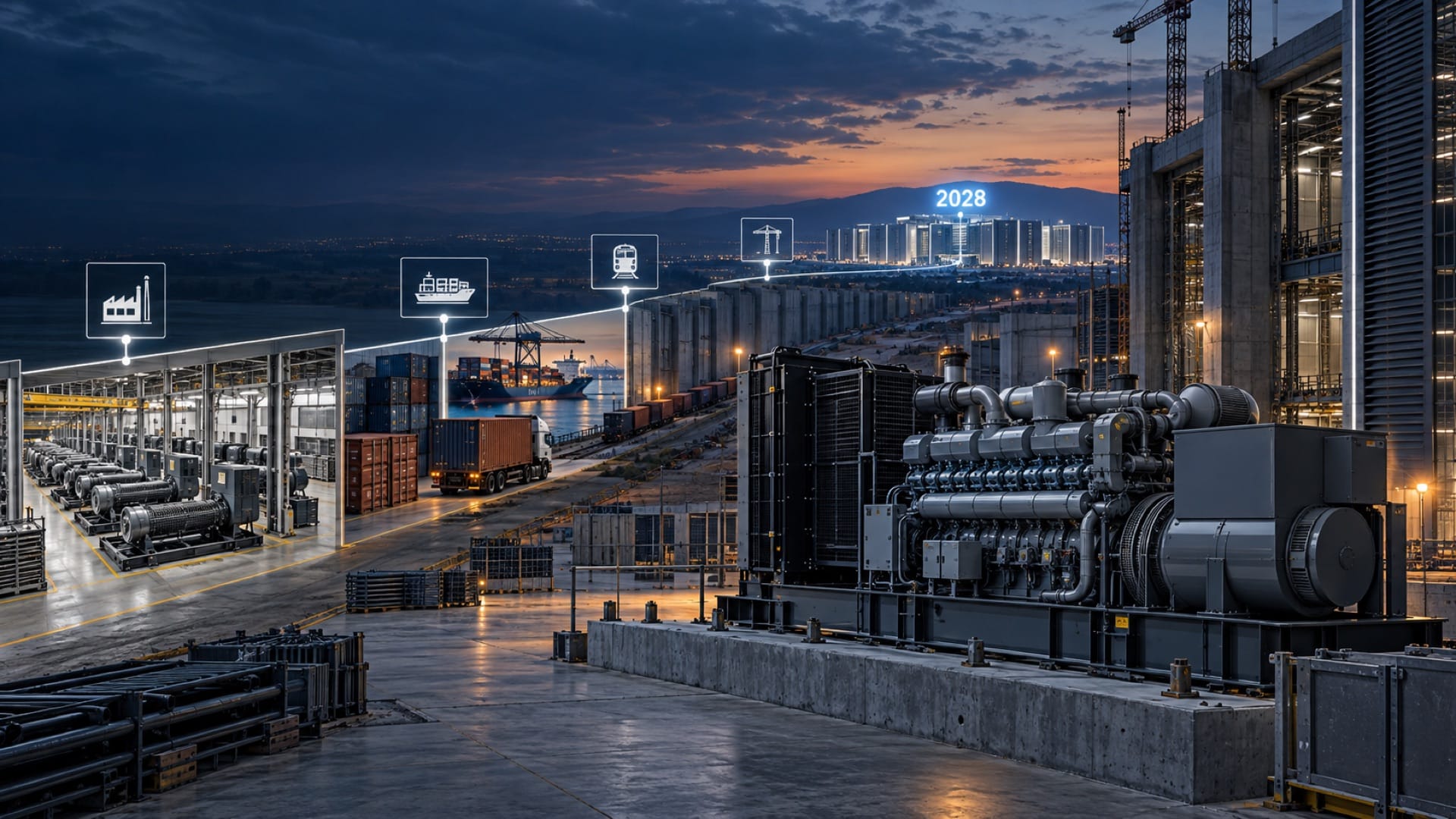
- Key takeaways: If you want generators on site for a 20 MW facility in 2028, the purchase order is due around Q4 2026 with a framework agreement – or Q2 2027 if you are a new buyer. That is now.
- Quoted OEM lead times in mid-2026: Caterpillar 3500 series 32-48 weeks, Rolls-Royce mtu 28-36, Cummins QSK 24-36. Those are order-to-ship, not order-to-site.
- Size drives everything. Below 2 MVA you are looking at 8-14 months; above 3 MVA it is 24-36 months for a framework buyer and 36-52 for a newcomer.
- The gap between a framework buyer and a first-time buyer is roughly a year on large units. Reserved capacity is now a procurement asset in itself.
- Evidence base: 102 signals from 32 sources. Honest limitation: OEMs publish quotes, buyers rarely publish what actually arrived – so this is strong on promised times and thin on verified delivery.
Everyone in this industry talks about grid connections and GPUs. Almost nobody talks about the boring diesel box that decides whether your facility can be commissioned at all – until the programme slips and someone finally asks when the generators were ordered.
So we went looking for the actual numbers: 102 signals from 32 sources on what European data center generator procurement really takes in 2026.
What the OEMs are quoting right now
| Manufacturer | Quoted lead time (mid-2026) | Platform |
|---|---|---|
| Caterpillar | 32-48 weeks | 3500 series |
| Rolls-Royce mtu | 28-36 weeks | Series 4000 class |
| Cummins | 24-36 weeks | QSK platforms |
| Mitsubishi | 14-20 weeks | S16R-PTA, OEM-integrated |
Read that table carefully, because it is the most commonly misused number in this business. Those are order-to-ship figures for an engine or a genset leaving a factory. They are not order-to-site, and they are certainly not order-to-commissioned. Add transport, customs, the custom enclosure, the fuel tank package, the crane day, and the site acceptance test.
Size changes the problem entirely
| Unit size | Framework buyer | New buyer |
|---|---|---|
| 1-2 MVA | 8-14 months | 12-20 months |
| 2-3 MVA | 12-24 months | 24-36 months |
| 3+ MVA | 24-36 months | 36-52 months |
Look at the right-hand column. On large units, being a first-time buyer costs you roughly a year against someone who already holds a framework agreement. That is not a discount question, it is a queue position question – and it is the single most actionable finding in this whole study.
The evidence for why is public. Caterpillar signed a long-term agreement with Hunt Energy that explicitly reserves OEM capacity against the queue. Cummins has multiyear agreements with a global hyperscaler covering several gigawatts of future genset demand. Rolls-Royce mtu is taking data center orders for 2027 and 2028. Generac built a 400 million dollar backlog in under a year on a new data center generator line. The capacity is being booked years ahead by people who move early.
Working backwards from 2028
This is the part worth pinning above your desk. If you want generators standing on site in 2028:
| Project size | PO due (framework buyer) | PO due (new buyer) |
|---|---|---|
| 5-10 MW | Q3 2026 | Q1 2027 |
| 20 MW | Q4 2026 | Q2 2027 |
| 50 MW | Q1 2027 | Q3 2027 |
| 100+ MW | Q2 2027 | Q4 2027 |
We are in the third quarter of 2026. For anything at 20 MW or above with a 2028 target, the decision window is open now and closing. Not “next budget cycle” – now.
The planning figures behind those dates: 24 months base for a 5-10 MW project (36 conservative), 32 months for 20 MW (42), 40 months for 50 MW (52), 52 months for 100+ MW (60). The recommended contingency from the evidence is at least six months, and twelve above 50 MW.
Why deliveries slip
Four causes show up repeatedly, and only one of them is about the engine: OEM capacity constraints on large units, logistics and port bottlenecks, component shortages, and customisation. That last one is the one buyers inflict on themselves. A standard unit ships on the quoted schedule; a bespoke enclosure with a particular tank arrangement quietly adds months that nobody wrote into the programme.
There is capacity coming. Caterpillar is putting 725 million dollars into its Lafayette engine plant to double output by 2027. Cummins committed 450 million to expand high-horsepower capacity. Rolls-Royce mtu is more than doubling its 2024 Series 4000 output in Mankato. The European genset market was around 11.1 billion dollars in 2025 and is projected to reach 24.3 billion by 2034. Whether that capacity arrives faster than AI demand is the open question – and the honest answer is that nobody knows yet.
What this study cannot tell you
I want to be straight about the limitation, because it matters for how you use these numbers. OEMs publish quoted lead times. Buyers almost never publish what actually turned up and when. So the evidence here is strong on promised timelines and genuinely thin on verified delivery – we could not build a defensible distribution of actual order-to-site times from public sources.
Which is exactly why the contingency matters. Plan against the quoted range, then add the buffer, then treat the OEM date as the optimistic case rather than the commitment.
📄 Full research report (102 signals, 32 sources, manufacturer-by-manufacturer analysis, size bands, 2027-2029 forecast scenarios – free PDF, no paywall): Data Center Generator Lead Times in Europe 2026
If you are building for 2028: when did you place the generator order – and does your programme still assume the quoted date? 👇
Get the next research first
I publish one evidence-based research report most weeks – free, no paywall, full PDF attached. Subscribe to Cloud, Colo & Data Center Pro and the next one reaches you the day it is out.
#DataCenters #PowerInfrastructure #Procurement #AIInfrastructure
Also published in my LinkedIn newsletter: Cloud, Colo & Data Center Pro
Related articles: