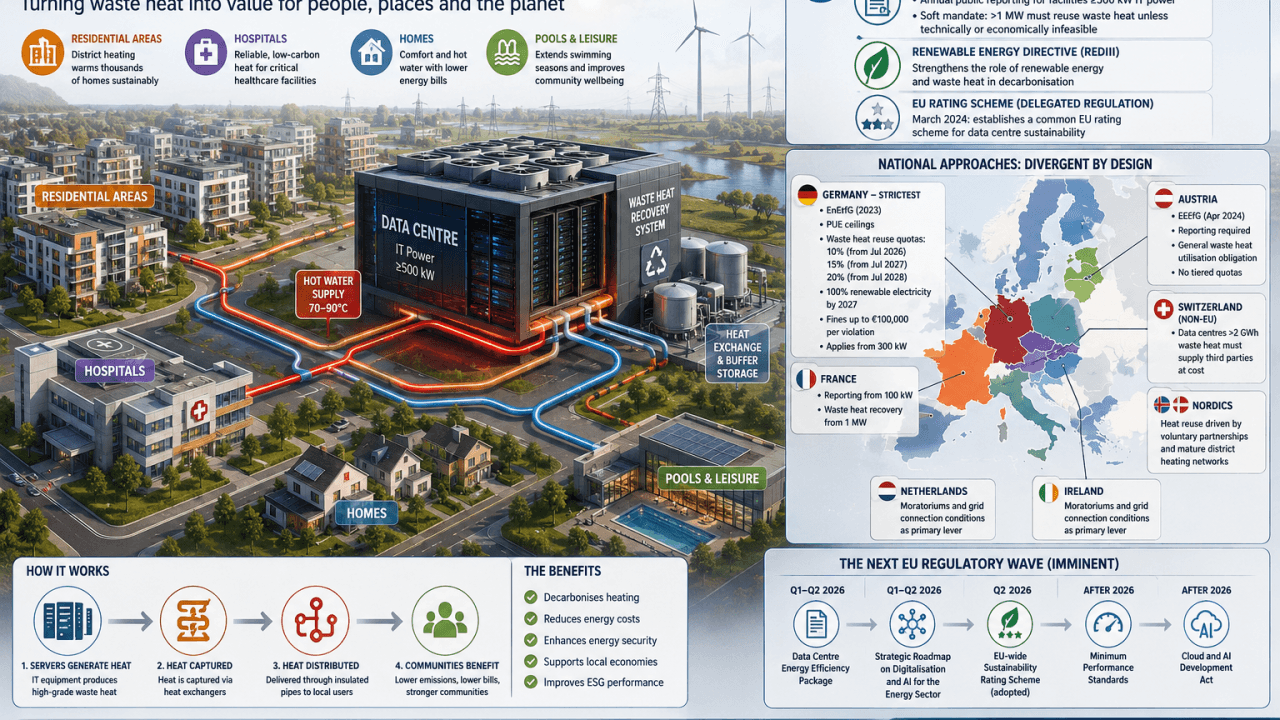
Data centre operators in the EU are now subject to binding energy and heat reuse rules, and the requirements differ sharply by country. This tracker summarises what applies where: the EU-wide framework, each national transposition, thresholds, quotas, deadlines and penalties – in one place. Last updated: 27 July 2026.
Key takeaways
- The EU Energy Efficiency Directive (EED, 2023/1791) requires annual public reporting for data centres with ≥500 kW IT power and waste heat reuse for facilities >1 MW unless technically or economically infeasible.
- Germany is the strictest market: waste heat reuse quotas of 10/15/20% from July 2026/2027/2028, 100% renewable electricity by 2027, PUE ceilings, and fines up to €100,000 – applying from just 300 kW.
- National approaches diverge widely: France regulates from 100 kW, Austria has obligations without quotas, the Nordics rely on voluntary district heating partnerships, the Netherlands and Ireland use moratoriums and grid connections as the lever.
- A second EU regulatory wave lands in 2026: the Data Centre Energy Efficiency Package, an EU-wide sustainability rating scheme, and an expected Cloud and AI Development Act.
- Site selection economics are shifting from “cheap power + cool climate” to “cheap power + cool climate + heat off-taker”.
The EU-wide framework
Three instruments form the federal layer. The recast Energy Efficiency Directive (EED, Directive (EU) 2023/1791, in force since 2023) created the first EU-wide obligations: annual public reporting of energy performance for data centres with an installed IT power demand of 500 kW or more, and a soft mandate for facilities above 1 MW to reuse waste heat unless it is technically or economically infeasible. The Renewable Energy Directive (REDIII) adds renewable energy obligations, and a March 2024 Delegated Regulation established a common EU rating scheme for data centre sustainability reporting.
Definitions
- EED – the EU Energy Efficiency Directive (2023/1791), the primary EU law regulating data centre energy performance.
- PUE (Power Usage Effectiveness) – total facility energy divided by IT energy; 1.0 is theoretically perfect, and regulatory ceilings typically target 1.2–1.5.
- Waste heat reuse – capturing heat rejected by IT equipment and supplying it to consumers such as district heating networks, instead of venting it to the atmosphere.
- Heat off-taker – a customer (city network, industrial site, campus) that accepts and uses a data centre’s waste heat.
Country-by-country tracker
| Country | Applies from | Key obligations | Enforcement |
|---|---|---|---|
| Germany (EnEfG, 2023) | 300 kW | PUE ceilings; hard waste heat reuse quotas of 10/15/20% from July 2026, 2027, 2028; 100% renewable electricity by 2027 | Fines up to €100,000 per violation |
| France | 100 kW (reporting) | Energy reporting from 100 kW; waste heat recovery obligations from 1 MW | National energy authority oversight |
| Austria (EEffG, April 2024) | Reporting thresholds per EED | Reporting plus a general waste heat utilisation obligation; no tiered quotas | Administrative penalties |
| Netherlands | Case-by-case | Moratoriums and grid connection conditions used as primary lever; hyperscale permits restricted | Permitting and grid access |
| Ireland | Case-by-case | De facto moratorium in Dublin region via grid connection policy | Grid operator (EirGrid) conditions |
| Nordics (SE, FI, DK, NO) | Voluntary | Heat reuse driven by mature district heating markets and commercial partnerships rather than mandates | Market-based |
| Switzerland (non-EU) | >2 GWh waste heat | Data centres above 2 GWh must supply waste heat to third parties at cost | Cantonal implementation |
The 2026 second wave
The European Commission has confirmed a Data Centre Energy Efficiency Package alongside the Strategic Roadmap on Digitalisation and AI for the Energy Sector (Q1–Q2 2026), plus an EU-wide sustainability rating scheme adopted in Q2 2026. Minimum performance standards and a Cloud and AI Development Act are expected to follow. For operators this means the reporting-only phase is ending: performance floors and rating-linked obligations are next.
What this means for operators and investors
- Site selection now has a third variable: proximity to a heat off-taker is becoming as important as power price and climate.
- High-temperature liquid cooling (60–70°C return water) turns compliance into revenue: it is near-ready district heating supply, while low-temperature loops need heat pumps in between.
- Germany rewards early movers: facilities designed for heat reuse gain a permitting argument, not just an ESG talking point.
- Retrofitting heat reuse into an existing air-cooled facility is far more expensive than designing for it – oversize pipes and reserve dry cooler positions in phase one.
Frequently asked questions
Do the EU rules apply to small server rooms?
No. The EED reporting obligation starts at 500 kW installed IT power. Germany goes further, applying national obligations from 300 kW, and France requires reporting from 100 kW.
Is waste heat reuse mandatory everywhere in the EU?
Not unconditionally. The EED requires reuse for facilities above 1 MW unless technically or economically infeasible – the feasibility test is the operative clause. Germany is the exception, with hard quotas that apply regardless.
Which EU country is hardest for data centre compliance?
Germany, by a distance: the lowest threshold (300 kW), hard reuse quotas, a renewable electricity mandate from 2027, PUE ceilings and six-figure fines.
Related articles
- Data Centre Waste Heat Reuse Regulation in the EU – the original analysis behind this tracker
- The Only Constant in a Modern Data Center Is Power – why 60–70°C return water is an asset
- The EU Compliance Machine: Who Does It Really Protect?
Get the next research first
I publish one evidence-based research report most weeks – free, no paywall, full PDF attached. Subscribe to Cloud, Colo & Data Center Pro and the next one reaches you the day it is out.