Europe Is Investing Heavily in AI Infrastructure – But There’s an Uncomfortable Gap We Don’t Talk About Enough

Key takeaways

  • EU funding for AI infrastructure (GPU clusters, supercomputers, data centers) is mostly CAPEX – the real long-term challenge is OPEX: electricity, cooling, engineers and upgrades.
  • Funding typically covers 2–5 year projects; afterwards either state budgets absorb the running costs or the infrastructure must become commercially viable.
  • Without sustainable operating models and an energy strategy, Europe risks building infrastructure that is underutilized, uncompetitive or financially unsustainable.
  • AI sovereignty requires funding outcomes, not just assets.

Across the EU, governments (with support from the European Commission) are funding GPU clusters, supercomputers, data centers and AI competence centers. This is great – and necessary. But most of this funding is CAPEX (buying and building the infrastructure).

EU funding for GPU clusters, supercomputers, data centers and AI competence centers

The real challenge? OPEX. Running AI at scale means:

  • ⚡ Massive electricity consumption
  • ❄️ Cooling and data center operations
  • 👨‍💻 Skilled engineers and ongoing maintenance
  • 🔄 Continuous hardware and software upgrades

And unlike the initial investment, these costs don’t go away.

In many cases, funding covers 2–5 year projects. After that:

  • Either the state budget absorbs the cost
  • Or the infrastructure must become commercially viable

That’s where things get tricky. Because AI today is not cheap:

  • Training models can cost millions
  • Even inference (serving models) requires constant GPU usage
  • Energy prices in Europe make everything more expensive

The result? We risk building impressive infrastructure that is underutilized, not globally competitive, or financially unsustainable long-term.

This isn’t a criticism – it’s a structural issue.

If Europe wants to be serious about AI sovereignty, we need to think beyond “building infrastructure” and address:

  • sustainable operating models
  • energy strategy for AI
  • public–private usage frameworks
  • long-term funding mechanisms

Otherwise, we’re funding assets – but not outcomes.

Curious to hear how others see this: Is Europe underestimating the cost of actually running AI?

#AI #Europe #DataCenters #HPC #Supercomputing #ArtificialIntelligence #DigitalInfrastructure #Energy #Innovation #TechPolicy #AIStrategy #capex #opex

https://www.linkedin.com/pulse/europe-investing-heavily-ai-infrastructure-theres-gap-gailitis-z4sbf

Related articles:
I Ran the Numbers: If You Filled a 1MW Data Center With iPhones – Here’s the Theoretical Compute Power You’d Get

Key takeaways

  • A 1MW data center could power about 250,000 iPhone 16 Pro Max units (~4W each under sustained load).
  • On paper that is ~1 ExaFLOP of FP32 GPU compute – exascale territory, rivaling the Frontier supercomputer.
  • Mobile chips are ~10x more power-efficient than data-center GPUs (~1 TFLOPS/W vs ~0.1 TFLOPS/W for an NVIDIA H100).
  • Reality check: thermal throttling, interconnect bandwidth and sustained-load limits make this a thought experiment, not a build plan.

Great thought experiment! Let me work through this. The newest iPhone is the iPhone 16 Pro Max (A18 Pro chip, released Sept 2024).

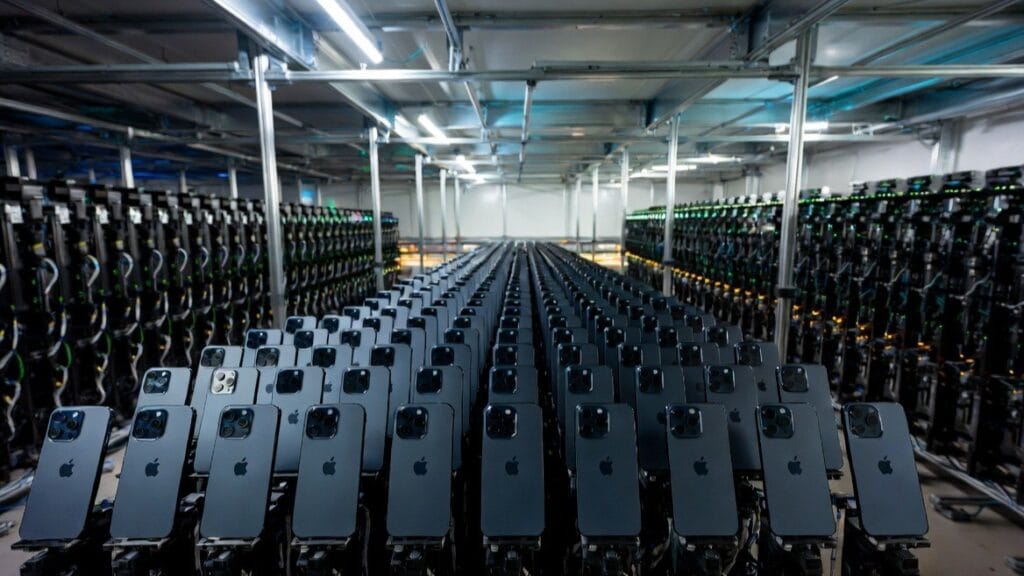
Server racks filled with iPhones in a 1MW data center thought experiment

How many iPhones? Under sustained heavy computational load, an iPhone 16 Pro Max draws roughly ~4 watts. That means 1,000,000W ÷ 4W = ~250,000 iPhones.

The A18 Pro chip has three compute engines.

GPU – ~4 TFLOPS (FP32) per device. 250,000 × 4 TFLOPS = 1 ExaFLOP – that’s exascale territory, matching the world’s most powerful supercomputers.

Neural Engine – 35 TOPS (INT8) per device. 250,000 × 35 TOPS = 8.75 PetaOPS for AI/ML inference workloads.

CPU – ~0.6 TFLOPS per device. 250,000 × 0.6 TFLOPS = ~150 PetaFLOPS.

Efficiency is actually impressive. The A18 Pro delivers roughly ~1 TFLOPS/W (GPU), while a data center-grade NVIDIA H100 GPU delivers ~0.1 TFLOPS/W (FP32). Mobile chips are extraordinarily power-efficient by comparison – they just can’t run continuously at peak without throttling.

Physical reality check: each iPhone 16 Pro Max is about 163 × 78 × 8.3 mm. 250,000 of them occupy roughly 26 cubic meters – filling only about 18 standard server racks physically, though cooling all those densely packed devices would be an engineering nightmare.

MetricValue
iPhones needed~250,000
GPU compute~1 ExaFLOP (FP32)
AI inference~8.75 PetaOPS (INT8)
Physical volume~26 m³ (~18 racks)
Cost (at ~$1,200/unit)~$300 million

The compute number is genuinely staggering – on paper it rivals Frontier, the world’s first exascale supercomputer – but of course real-world use would be limited by thermal throttling, interconnect bandwidth, and the fact that iPhones aren’t designed for sustained 100% load.

#DataCenters #AIInfrastructure #Compute #iPhone #HPC #EnergyEfficiency

https://www.linkedin.com/pulse/i-ran-numbers-you-filled-1mw-data-center-iphones-heres-gailitis-0rvtc

Related articles:

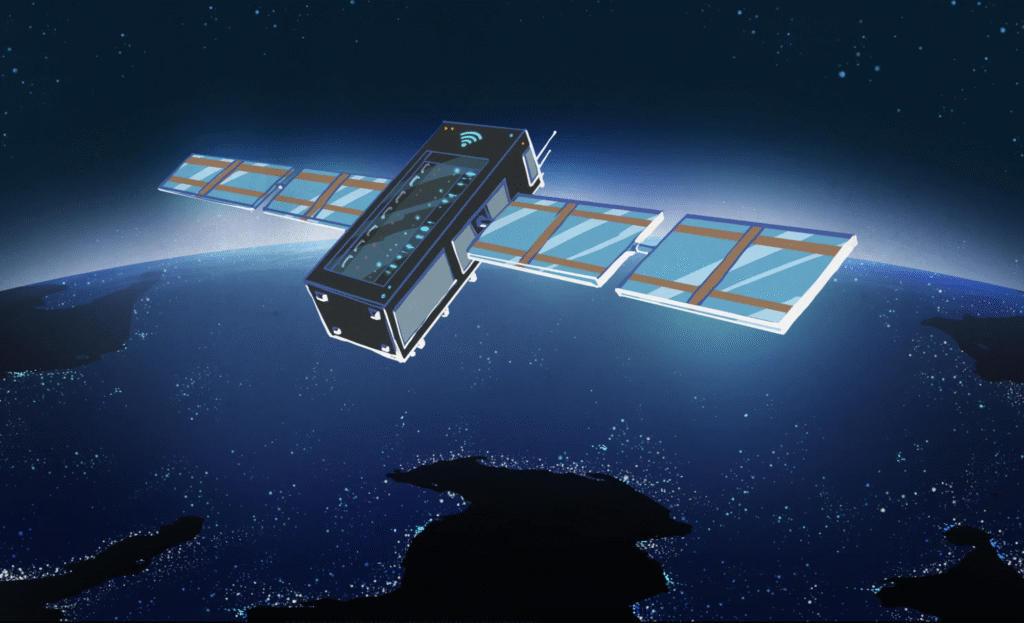
The future of AI computing is blasting off into orbit!

Key takeaways

  • In November 2025, Starcloud-1 trained AI models in orbit on an NVIDIA H100 – the first AI model training in space.
  • Orbital data centers promise near-constant solar power (up to 8x more effective than ground panels), zero water cooling and unlimited scalability.
  • Starcloud, Aetherflux, SpaceX, Blue Origin, Google and Europe’s ASCEND project are all racing toward orbital compute.
  • Main challenges – deployable radiators, radiation hardening, latency and launch costs – are falling fast.

As explosive AI growth pushes terrestrial data centers to their limits – devouring massive electricity, guzzling billions of gallons of water for cooling, facing land shortages, permitting delays, and grid overloads – a revolutionary alternative is emerging: orbital data centers.What once sounded like pure sci-fi is now reality. Just last month (November 2025), Nvidia-backed startup Starcloud (formerly Lumen Orbit) launched Starcloud-1, a compact satellite carrying a full Nvidia H100 GPU – 100x more powerful than any prior space compute hardware.And it worked spectacularly: In orbit, they successfully trained and ran multiple AI models, including Andrej Karpathy’s NanoGPT on the complete works of Shakespeare, and Google’s open-source Gemma LLM. This marks the first-ever AI model training in space, proving data-center-class GPUs can thrive in orbit.The advantages are mind-blowing:

The current image has no alternative text. The file name is: Screenshot-2025-12-13-at-11.23.49.png
  • Near-constant solar power: In optimized sun-synchronous orbits, satellites get up to 8x more effective energy than ground panels, with no night cycles or weather interruptions.
  • Zero water cooling: Waste heat radiates directly into the cold vacuum of space – no evaporation towers, no freshwater strain.
  • Unlimited scalability: No land acquisition, no local opposition, no grid upgrades needed.
  • Potentially 10x lower long-term costs: Even factoring launches, abundant clean energy and passive cooling slash operational expenses.
  • Sustainability boost: Orbital facilities could dramatically cut AI’s carbon footprint while preserving Earth’s precious resources.

The momentum is unstoppable. Major players are racing ahead:

  • Starcloud plans clusters with multiple H100s and Nvidia’s next-gen Blackwell GPUs in 2026–2027, targeting commercial workloads like satellite imagery inference for disaster response.
  • Aetherflux unveiled “Galactic Brain” – aiming for the first commercial orbital AI node in Q1 2027, leveraging space solar for unrestricted compute.
  • SpaceX (via Elon Musk) is adapting high-power Starlink V3 satellites for AI processing, with massive deployment potential via Starship.
  • Blue Origin has been quietly developing orbital data center tech for over a year.
  • Google’s Project Suncatcher explores solar-powered AI satellite constellations.
  • Axiom Space launching orbital data nodes soon.
  • Europe’s ASCEND project (led by Thales Alenia Space) confirmed feasibility for gigawatt-scale by mid-century.

Of course, real engineering challenges exist. Cooling dense racks demands large deployable radiators (governed by Stefan-Boltzmann radiation physics), radiation hardening for reliable operation, occasional latency for ground links, and upfront launch costs. But plummeting reusable rocket prices (thanks to Starship), innovative lightweight radiators, and proven demos like Starcloud-1 are rapidly closing those gaps.We’re witnessing the dawn of a new era: Abundant, green, scalable compute powering the AI revolution without burdening our planet. Orbital data centers aren’t just hype – they’re the sustainable path forward.What excites you most about this frontier? Will space host the world’s largest AI factories by 2040? Drop your thoughts below!

Subscribe & Share now if you are building, operating, and investing in the digital infrastructure of tomorrow.

#AI #SpaceTech #Innovation #ArtificialIntelligence #Sustainability #FutureOfComputing #OrbitalDataCenters #SpaceAI #AIRevolution #SustainableTech #TechInnovation #DeepTech

https://www.linkedin.com/pulse/future-ai-computing-blasting-off-orbit-andris-gailitis-c2ewf

Related articles:

AI Inside AI: How Data Centers Can Use AI to Run AI Workloads Better

Key takeaways

  • AI can run the AI data center: instant temperature and airflow forecasting, predictive maintenance from sensor data, and energy-aware scheduling of training jobs.
  • Real-time monitoring of PUE, WUE and carbon intensity turns efficiency into an operational discipline.
  • AI also covers security anomaly detection, GPU health forecasting, incident “fire drills” and automated compliance reporting.
  • If you host AI workloads, your operations should be AI-driven too – a necessity, not a choice.

AI Inside AI: How Data Centers Can Use AI to Run AI Workloads Better

This is a high-stakes AI workload host challenge—the machinery has a dense GPU cluster but also hard-to-predict demand and extreme cooling demands. However, the same technology pushing this sort of workload in the future will also help the center run more smoothly, safely, and environmentally friendly.

How to use AI to manage the AI data center in 10 steps:

1. AI models instantly forecast temperature changes. These models can render instant forecasts of airflow patterns to compensate for hot areas by, for example, fitting a contained LC unit that translates recycling air with an independent refrigeration system into cooling power delivered directly on top of electronic parts needing it.

2. Use vibration, power draw, and sensor data from chillers, UPSes, and PDUs to target those pieces of equipment that are likely to break long before they do.

3. Energy-Aware Scheduler for AI Training Jobs. Run the workloads at times when there is a cleaner grid and send those on out to areas with more wind turbines.

4. Optimizing Scheduling of AI Workloads. Spreading GPU-heavy jobs across clusters in order to even out the load saves one region from overloading while others wait.

5. Real-time Adaptive Efficiency Monitoring constantly observes PUE, WUE, and Carbon intensity with real-time recommendations to operations—if everything looks efficient, let’s not get hasty and take a risk that could put us out of business.

6. Building-Intelligence Video-Surveillance Security Anomaly Detection. Scans access logs, security cameras, and network traffic for signs of someone trying to break in.

7. Feature: GPU/TPU Hardware-Health Forecasting. Identifies symptoms of degeneration—error rates increasing, components overheating or running slow—for replacement before training jobs fail entirely.

8. Incident simulation and response planning. Running digital “fire drills” to see what the plant would do when: cooling failed, power was lost, or if there were a cyber attack.

9. Real-time automated compliance reporting ISO, SOC, etc. Using the operational logs of the facility to onboard customers faster. Pulls from system/operational logs for audit reports on-demand (reliable and consistent & audit-ready).

10. Automated GPU node on/off with Intelligent Resource Scaling. It won’t turn on GPU nodes just because you’re using them, it will also try to keep energy costs down through effective management.

In the end, if you have an AI host, then your business should be AI-driven too. It is not a matter of choice, but of necessity in order to deal with the scale and complexity of these modern AI workloads, that we begin using machine intelligence for both heating control and cooling spot-by-spot because it simply has become routine everywhere else.

Subscribe & Share now if you are building, operating, and investing in the digital infrastructure of tomorrow.

#DataCenter #CloudComputing #HostingSolutions #GreenTech #SustainableHosting #AI #ArtificialIntelligence #EcoFriendly #RenewableEnergy #DataStorage #TechForGood #SmartInfrastructure #DigitalTransformation #CloudHosting #GreenDataCenter #EnergyEfficiency #FutureOfTech #Innovation #TechSustainability #AIForGood

https://www.linkedin.com/pulse/ai-inside-how-data-centers-can-use-run-workloads-better-gailitis-1hjzf

Related articles:

Proudly powered by WordPress | Theme: Baskerville 2 by Anders Noren.

Up ↑