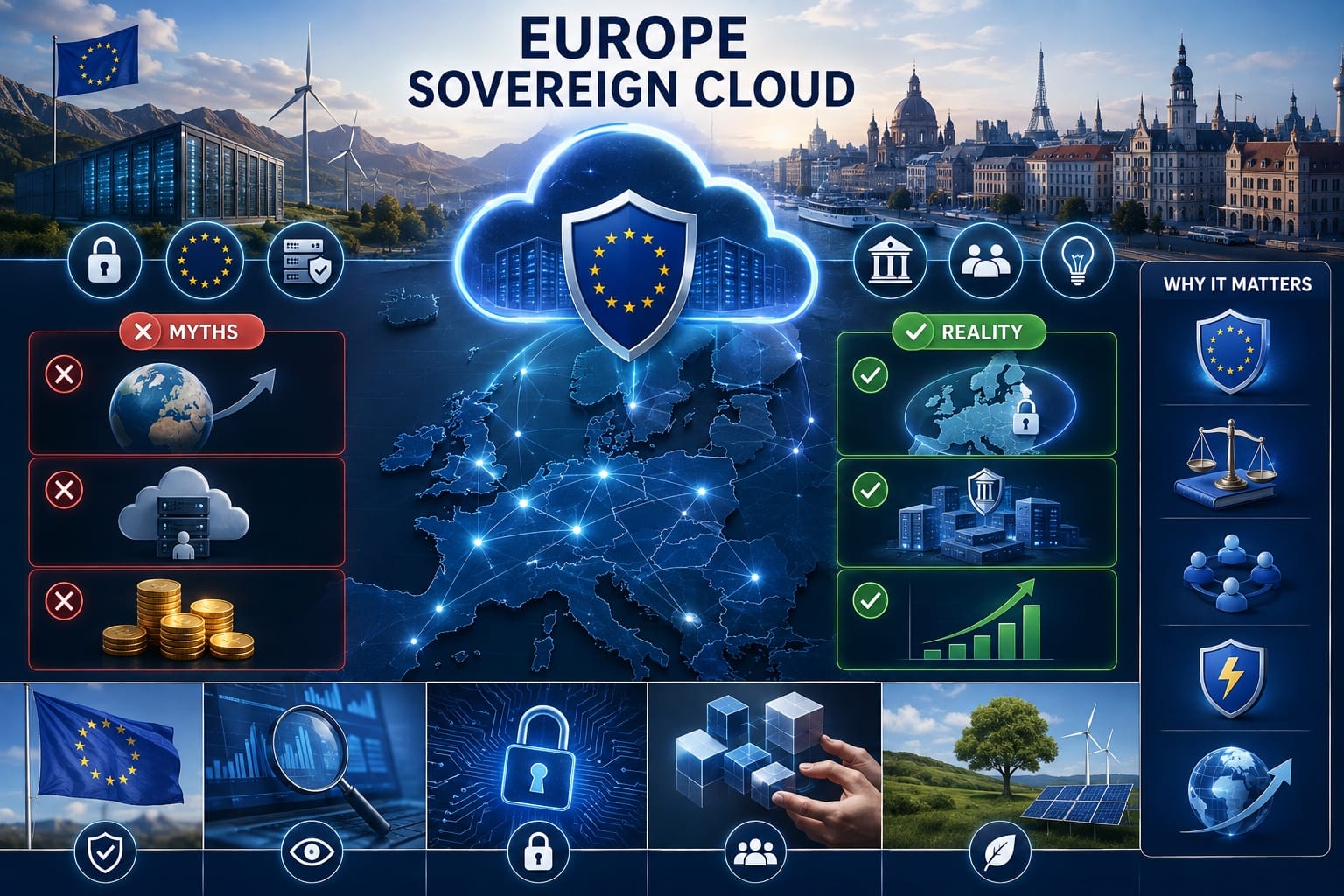
- Key takeaways: In April 2026 the European Commission awarded the EUR 180M Cloud III framework to four European providers – Post Telecom, STACKIT, Scaleway and Proximus. Sovereign cloud is now a purchase order, not a position paper.
- We identified 224 sovereign-cloud contracts across Europe. The 129 with public values total EUR 18.2 billion – and 43% of contracts never publish a value at all.
- Supply-chain sovereignty now carries 20% of the EU evaluation score. STACKIT and Scaleway qualified at SEAL-3, the highest level awarded in this round.
- Our base scenario implies roughly EUR 10.4 billion per year of infrastructure spend and about 7,400 MW of European data center demand by 2029 – a model estimate with explicit assumptions, full methodology in the attached PDF.
For most of a decade, “sovereign cloud” lived in panel discussions and position papers. In April 2026 it became a purchase order: the European Commission awarded a EUR 180 million framework for sovereign cloud services to four European providers – Post Telecom (with OVHcloud and Clever Cloud), STACKIT, Scaleway and Proximus (with S3NS, Clarence and Mistral). Six-year contracts. Real money, real workloads.
The interesting part is not the amount. It is the scoring. Under the EU Cloud Sovereignty Framework, providers had to meet defined sovereignty levels (SEAL), and supply chain sovereignty alone was weighted at 20% of the evaluation. STACKIT and Scaleway qualified at SEAL-3; the two consortia at SEAL-2. For the first time, a major public buyer scored cloud providers on who controls the supply chain – not only on price and features.
And this is not one Brussels tender. We compiled 224 sovereign-cloud contracts across Europe; the 129 with public values total EUR 18.2 billion. Italy signed ten-year public sector cloud deals worth EUR 3.6 billion. France put EUR 1.8 billion behind its cloud sovereignty program built around SecNumCloud. Belgium’s G-Cloud runs at roughly EUR 1.8 billion over six years. Austria awarded EUR 351 million to its Federal Computing Centre. The other 43% of contracts publish no value at all – which means the real market is larger than what you can count.
Does “sovereign” mean “no Americans”? No – and the evidence is unambiguous. AWS has launched a European Sovereign Cloud. Google entered through S3NS, a joint venture with Thales. Microsoft backs the German sovereign platform through Delos. In practice, sovereignty is becoming a control layer: EU jurisdiction, EU operations, EU supply chains – sometimes running on top of non-EU technology. That favors whoever can provide the European layer.
Now the part that matters for my industry: every sovereign workload lands on physical infrastructure, and certified facilities in the right jurisdiction are the scarce ingredient. We modeled what identified procurement implies for data center demand by 2029:
| Scenario | Implied market by 2029 | Infra spend 2029 | DC demand 2029 |
|---|---|---|---|
| Conservative | EUR 36.5B | EUR 4.2B / year | ~3,000 MW |
| Base | EUR 60.8B | EUR 10.4B / year | ~7,400 MW |
| Accelerated | EUR 121.6B | EUR 32.4B / year | ~23,000 MW |
One honest caveat: these are implied estimates built from explicit assumptions (35% of cloud spend flowing to infrastructure, EUR 1.4M per MW-year), not measured market sizes. The full methodology, with every assumption listed, is in the attached report.
The Baltics are a small but telling test case. Estonia runs its national cloud platform through a state IT center, Latvia is building a national federated cloud around its state infrastructure operator, and Lithuania is consolidating on a hybrid model. The striking fact: for most large national cloud tenders in the region, no public winners have been announced yet. This is a market where the big hosting contracts are still on the table.
My operator read is simple. Certifications are becoming the ticket to play – EUCS, SEAL levels, national schemes. Capacity in the right jurisdiction is starting to matter more than capacity in general. And the most predictable buyers of the next three years are not startups – they are governments with regulatory deadlines.
📄 Full research report (224 contracts, country-by-country analysis, scenario model, all sources – free PDF, no paywall): EU Sovereign Cloud Research 2026
Is sovereign cloud on your procurement radar yet – as a buyer, or as a provider? 👇
Get the next research first
I publish one evidence-based research report most weeks – free, no paywall, full PDF attached. Subscribe to Cloud, Colo & Data Center Pro and the next one reaches you the day it is out.
#SovereignCloud #CloudComputing #DigitalSovereignty #DataCenters
Also published in my LinkedIn newsletter: Cloud, Colo & Data Center Pro
Related articles: