Liquid Cooling vs Air Cooling in Data Centers: The Real Economics

Liquid cooling is cheaper to operate than air cooling at scale for one dominant reason: every megawatt moved from air to liquid escapes the chiller – the most expensive component in the cooling chain. But air cooling never disappears entirely. This guide explains the real economics of the air/liquid split in an AI-era data center, based on our experience planning new builds at DELSKA.

Key takeaways

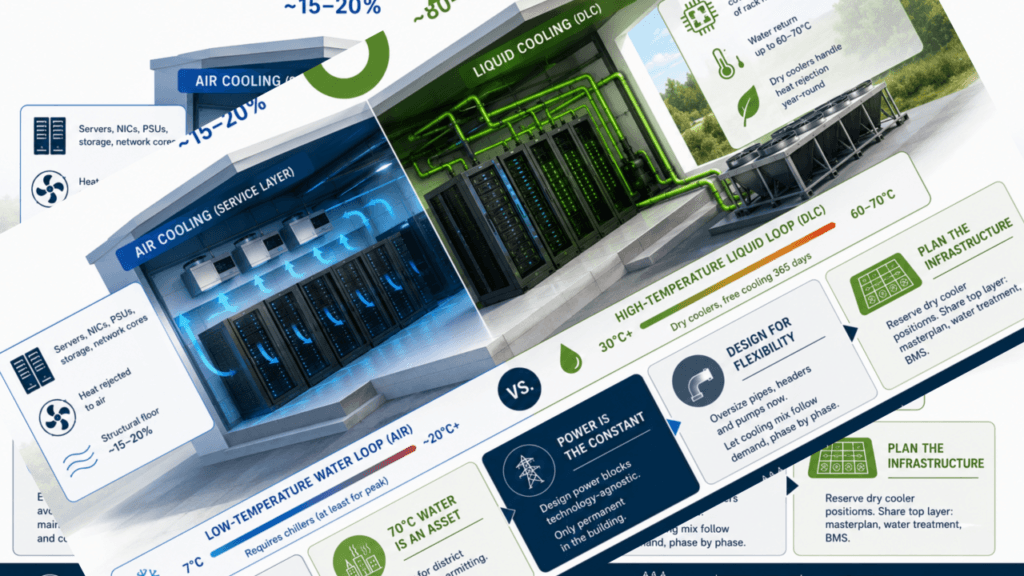
  • Direct-to-chip liquid cooling captures roughly 70–85% of rack heat; memory, NICs, power supplies and optics still reject to air, creating a structural floor of about 15–20% air cooling in any large deployment.
  • Air and liquid are different thermodynamic worlds: the air loop runs on low-temperature water (about 7°C to low-20s°C) and needs chillers; the high-temperature liquid loop returns water at 60–70°C and can reject heat with dry coolers alone, year-round, almost anywhere in Europe.
  • The “chiller tax” is the economic core: chillers carry the highest capex, maintenance, F-gas regulatory exposure and compressor energy – hitting PUE directly. Liquid megawatts do not pay it.
  • At 60–70°C, return water is near-ready district heating supply – in Germany a permitting argument and a potential revenue line under the Energy Efficiency Act.
  • Design conclusion: fix the power blocks, not the cooling ratio. Make power infrastructure technology-agnostic and let the cooling mix follow tenant demand.

Definitions

  • Direct-to-chip (DLC) liquid cooling – cold plates on CPUs/GPUs transfer heat to a liquid loop, removing the majority of rack heat without moving air.
  • Chiller – a compressor-based refrigeration machine producing chilled water for the air-cooling loop; the most expensive element of the chain in capex, maintenance and energy.
  • Dry cooler – a heat exchanger rejecting heat to ambient air without compressors or refrigerants; works alone when loop temperatures are high enough.
  • PUE (Power Usage Effectiveness) – total facility power divided by IT power; compressor energy is one of its biggest drivers.
  • Chiller tax – our shorthand for the combined capex, opex, F-gas exposure and PUE penalty that every air-cooled megawatt carries and liquid-cooled megawatts avoid.

Air vs liquid: the comparison

DimensionAir cooling loopHigh-temp liquid loop (DLC)
Working temperature~7°C to low-20s°C water60–70°C return water
Heat rejectionChillers required (at least for peak trimming)Dry coolers alone, 365 days, virtually anywhere in Europe
Compressors / refrigerantsYes – capex, maintenance, F-gas exposureNone
PUE impactCompressor energy hits PUE directlyMinimal mechanical cooling energy
Share of rack heat (AI hall)Structural floor of ~15–20%~70–85% via direct-to-chip
Heat reuse readinessNeeds heat pump upgrade to be usefulNear district-heating grade as-is
Scaling behaviourShare shrinks as facility growsShare grows with rack density

Why the air share shrinks as facilities scale

When we started planning our new builds we assumed roughly 20% air / 80% liquid. Then we noticed the larger the facility gets, the smaller the air percentage becomes – not by choice, but because physics and economics push it there. Every air-cooled megawatt pays the chiller tax; every liquid megawatt escapes it into dry cooler economics. At scale, that difference compounds.

And yet air never reaches zero. Even in a “fully liquid” AI hall, the residual heat from memory, NICs, power supplies and optics – plus network cores, storage and support infrastructure – lands at about 15–20% air. That is not a design choice. That is physics, at least until chip makers eliminate air-cooled components entirely.

Two loops, not one

One shared water system is not realistic: the loops live at completely different temperatures. What you can share is the top layer – the heat rejection field masterplan, water treatment, and BMS. The hydraulic circuits stay separate.

Waste heat: from cost to revenue

At high-temperature DLC return levels you are sitting on near-ready district heating supply. In Germany, where the Energy Efficiency Act requires heat reuse readiness for large data centers, 60–70°C return water stops being an ESG talking point and becomes a permitting argument – and potentially a revenue line. Lower-temperature loops need a heat pump in between. See the EU Data Centre Regulation Tracker for country-by-country heat reuse rules.

The design conclusion: fix the power blocks

Do not fix the air/liquid ratio in concrete. Design transformers, distribution and UPS topology to be technology-agnostic. Oversize pipes, headers and pump capacity in phase one – cheap now, brutally expensive later – and pre-reserve dry cooler positions in the field masterplan. Then let the cooling mix follow tenant demand, phase by phase. Only one thing in the building is permanent: power.

Frequently asked questions

Can a data center be 100% liquid cooled?

Not today. Direct-to-chip captures 70–85% of rack heat, but memory, power supplies, optics, network and storage still reject heat to air – a structural floor of roughly 15–20% until component design changes.

Does liquid cooling improve PUE?

Yes, primarily by removing compressor energy: high-temperature loops reject heat through dry coolers without chillers, and chiller compressor energy is one of the largest PUE drivers in air-cooled facilities.

Is liquid cooling worth it for existing facilities?

Retrofits are far more expensive than new builds designed for it. The economical path is hybrid: keep the air loop as a service layer and add liquid capacity where rack density demands it – if the pipes and pumps were sized for it in phase one.

Related articles

EU Data Centre Regulation Tracker: Energy, Heat Reuse and PUE Rules by Country

Data centre operators in the EU are now subject to binding energy and heat reuse rules, and the requirements differ sharply by country. This tracker summarises what applies where: the EU-wide framework, each national transposition, thresholds, quotas, deadlines and penalties – in one place. Last updated: 27 July 2026.

Key takeaways

  • The EU Energy Efficiency Directive (EED, 2023/1791) requires annual public reporting for data centres with ≥500 kW IT power and waste heat reuse for facilities >1 MW unless technically or economically infeasible.
  • Germany is the strictest market: waste heat reuse quotas of 10/15/20% from July 2026/2027/2028, 100% renewable electricity by 2027, PUE ceilings, and fines up to €100,000 – applying from just 300 kW.
  • National approaches diverge widely: France regulates from 100 kW, Austria has obligations without quotas, the Nordics rely on voluntary district heating partnerships, the Netherlands and Ireland use moratoriums and grid connections as the lever.
  • A second EU regulatory wave lands in 2026: the Data Centre Energy Efficiency Package, an EU-wide sustainability rating scheme, and an expected Cloud and AI Development Act.
  • Site selection economics are shifting from “cheap power + cool climate” to “cheap power + cool climate + heat off-taker”.

The EU-wide framework

Three instruments form the federal layer. The recast Energy Efficiency Directive (EED, Directive (EU) 2023/1791, in force since 2023) created the first EU-wide obligations: annual public reporting of energy performance for data centres with an installed IT power demand of 500 kW or more, and a soft mandate for facilities above 1 MW to reuse waste heat unless it is technically or economically infeasible. The Renewable Energy Directive (REDIII) adds renewable energy obligations, and a March 2024 Delegated Regulation established a common EU rating scheme for data centre sustainability reporting.

Definitions

  • EED – the EU Energy Efficiency Directive (2023/1791), the primary EU law regulating data centre energy performance.
  • PUE (Power Usage Effectiveness) – total facility energy divided by IT energy; 1.0 is theoretically perfect, and regulatory ceilings typically target 1.2–1.5.
  • Waste heat reuse – capturing heat rejected by IT equipment and supplying it to consumers such as district heating networks, instead of venting it to the atmosphere.
  • Heat off-taker – a customer (city network, industrial site, campus) that accepts and uses a data centre’s waste heat.

Country-by-country tracker

CountryApplies fromKey obligationsEnforcement
Germany (EnEfG, 2023)300 kWPUE ceilings; hard waste heat reuse quotas of 10/15/20% from July 2026, 2027, 2028; 100% renewable electricity by 2027Fines up to €100,000 per violation
France100 kW (reporting)Energy reporting from 100 kW; waste heat recovery obligations from 1 MWNational energy authority oversight
Austria (EEffG, April 2024)Reporting thresholds per EEDReporting plus a general waste heat utilisation obligation; no tiered quotasAdministrative penalties
NetherlandsCase-by-caseMoratoriums and grid connection conditions used as primary lever; hyperscale permits restrictedPermitting and grid access
IrelandCase-by-caseDe facto moratorium in Dublin region via grid connection policyGrid operator (EirGrid) conditions
Nordics (SE, FI, DK, NO)VoluntaryHeat reuse driven by mature district heating markets and commercial partnerships rather than mandatesMarket-based
Switzerland (non-EU)>2 GWh waste heatData centres above 2 GWh must supply waste heat to third parties at costCantonal implementation

The 2026 second wave

The European Commission has confirmed a Data Centre Energy Efficiency Package alongside the Strategic Roadmap on Digitalisation and AI for the Energy Sector (Q1–Q2 2026), plus an EU-wide sustainability rating scheme adopted in Q2 2026. Minimum performance standards and a Cloud and AI Development Act are expected to follow. For operators this means the reporting-only phase is ending: performance floors and rating-linked obligations are next.

What this means for operators and investors

  • Site selection now has a third variable: proximity to a heat off-taker is becoming as important as power price and climate.
  • High-temperature liquid cooling (60–70°C return water) turns compliance into revenue: it is near-ready district heating supply, while low-temperature loops need heat pumps in between.
  • Germany rewards early movers: facilities designed for heat reuse gain a permitting argument, not just an ESG talking point.
  • Retrofitting heat reuse into an existing air-cooled facility is far more expensive than designing for it – oversize pipes and reserve dry cooler positions in phase one.

Frequently asked questions

Do the EU rules apply to small server rooms?

No. The EED reporting obligation starts at 500 kW installed IT power. Germany goes further, applying national obligations from 300 kW, and France requires reporting from 100 kW.

Is waste heat reuse mandatory everywhere in the EU?

Not unconditionally. The EED requires reuse for facilities above 1 MW unless technically or economically infeasible – the feasibility test is the operative clause. Germany is the exception, with hard quotas that apply regardless.

Which EU country is hardest for data centre compliance?

Germany, by a distance: the lowest threshold (300 kW), hard reuse quotas, a renewable electricity mandate from 2027, PUE ceilings and six-figure fines.

Related articles

The Only Constant in a Modern Data Center Is Power

Key takeaways

  • Direct-to-chip liquid cooling captures 70–85% of rack heat; the rest still rejects to air – a structural floor of about 15–20% air in any large deployment.
  • Air and liquid loops run at completely different temperatures (about 7–20°C vs 60–70°C) and cannot realistically share one water system.
  • Every megawatt moved from air to liquid escapes the “chiller tax” – the capex, maintenance, F-gas exposure and PUE penalty of compressor-based cooling.
  • Design conclusion: keep power infrastructure technology-agnostic and let the cooling mix follow tenant demand.

Everything else – especially cooling – is a variable.

Air cooling vs liquid cooling loops in a modern AI data center

When we started planning our new data center builds, we began with what felt like a safe assumption: roughly 20% air cooling, 80% liquid. A reasonable split for an AI-era facility.

Then we noticed something. The larger the facility gets, the smaller the air percentage becomes – not because we decided so, but because the physics and the economics push it there. And yet air never reaches zero. Here’s what we’ve learned designing around that tension.

Air cooling doesn’t disappear – it becomes a service layer.

Even in a “fully liquid” AI hall, direct-to-chip cooling captures roughly 70–85% of rack heat. The rest – memory, NICs, power supplies, optics – still rejects to air. Add network cores, storage, and support infrastructure, and you land at a structural floor of about 15–20% air in any large deployment. That’s not a design choice. That’s physics, at least until chip makers eliminate air-cooled components entirely.

These are two different thermodynamic worlds.

Here’s what gets glossed over in most “hybrid cooling” discussions: air and liquid loops don’t just differ in medium – they live at completely different temperatures.

The air-cooling loop is a low-temperature water system, typically operating anywhere from about 7°C up to the low-20s°C depending on facility design and economization strategy – which means chillers, at least for peak trimming. By contrast, the high-temperature liquid-cooling loop can return water at 60–70°C – and at those temperatures, dry coolers alone handle heat rejection year-round, virtually anywhere in Europe. No compressors. No refrigerants. Free cooling, 365 days.

One shared water system? Not realistically. What you can share is the top layer: the heat rejection field masterplan, water treatment, BMS. The hydraulic circuits themselves stay separate.

Every megawatt you move from air to liquid escapes the chiller tax. This is the economic insight hiding inside the ratio question. Chillers are the most expensive component of the cooling chain – capex, maintenance, F-gas regulatory exposure, and above all compressor energy that hits your PUE directly.

Shift a megawatt from air to liquid, and it doesn’t just change cooling technology. It moves from chiller economics to dry cooler economics. That’s why the air percentage naturally shrinks as facilities scale: every air-cooled megawatt carries a chiller tax that liquid megawatts don’t pay.

70°C return water isn’t waste – it’s an asset. At high-temperature DLC return levels, you’re sitting on near-ready district heating supply. In Germany, where the Energy Efficiency Act already requires heat reuse readiness for large data centers, this stops being an ESG talking point and becomes a permitting argument – and potentially a revenue line. Lower-temperature liquid loops need a heat pump in between; at 60–70°C, you’re much closer to plug-and-play.

So what does this mean for design? Our conclusion: don’t fix the air/liquid ratio in concrete. Fix the power blocks.

Design power infrastructure – transformers, distribution, UPS topology – to be technology-agnostic. Oversize the pipes, headers, and pump capacity in phase one (cheap now, brutally expensive later). Then let the cooling mix follow tenant demand, phase by phase, with dry cooler positions pre-reserved in the field masterplan.

Because in the end, only one thing in the building is permanent: power. Everything downstream of the busbar should be ready to change.

How are you approaching the air/liquid split in your new builds? Curious whether others are seeing the same structural floor around 15–20% air.

#DataCenters #LiquidCooling #AIInfrastructure #Sustainability #DistrictHeating #PUE

https://www.linkedin.com/pulse/only-constant-modern-data-center-power-andris-gailitis-jayrf

Related articles:

Data Centre Waste Heat Reuse Regulation in the EU

Key takeaways

  • The EU Energy Efficiency Directive (2023/1791) requires annual public reporting from 500 kW IT power and waste heat reuse above 1 MW unless infeasible.
  • Germany is the strictest: reuse quotas of 10/15/20% from July 2026/2027/2028, 100% renewable electricity by 2027, fines up to €100,000 – from just 300 kW.
  • National rules diverge: France regulates from 100 kW, Austria has no quotas, the Nordics rely on voluntary district heating partnerships, the Netherlands and Ireland use moratoriums and grid access.
  • A second EU wave arrives in 2026 – site selection is shifting to “cheap power + cool climate + heat off-taker”.

Heat reuse from data centres is no longer purely voluntary in Europe. The 2023 recast Energy Efficiency Directive (EED, Directive (EU) 2023/1791) created the first EU-wide framework: annual public reporting for facilities ≥500 kW IT power, and a soft mandate for facilities >1 MW to reuse waste heat unless technically or economically infeasible. The Renewable Energy Directive (REDIII) and a March 2024 Delegated Regulation establishing a common EU rating scheme complete the federal layer.

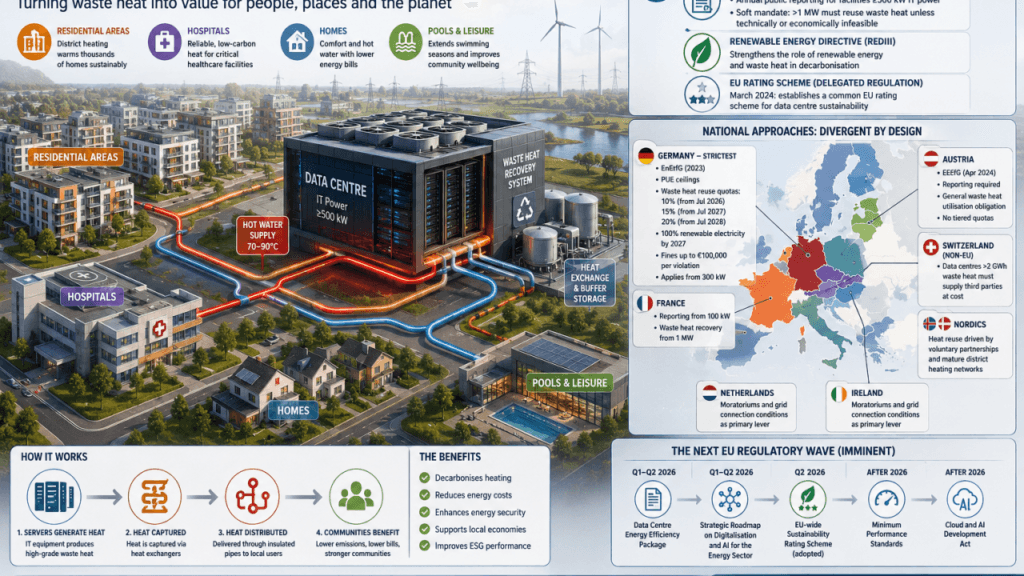
Map and overview of EU data centre waste heat reuse regulation by country

National transpositions diverge sharply. Germany’s Energy Efficiency Act (EnEfG, 2023) is the strictest: PUE ceilings, hard waste heat reuse quotas (10/15/20% from July 2026, 2027, 2028), 100% renewable electricity by 2027, and fines up to €100,000 per violation, applied from 300 kW. France imposes reporting from 100 kW and waste heat recovery from 1 MW. Austria’s EEffG (April 2024) introduces reporting and a general waste heat utilisation obligation but no tiered quotas. Switzerland (non-EU) requires data centres >2 GWh waste heat to supply third parties at cost. The Nordics drive heat reuse mostly through voluntary partnerships with mature district heating networks rather than mandates. The Netherlands and Ireland have used moratoriums and grid connection conditions as their primary lever.

A second EU regulatory wave is now imminent. The Commission has confirmed a Data Centre Energy Efficiency Package alongside the Strategic Roadmap on Digitalisation and AI for the Energy Sector in Q1–Q2 2026, plus an EU-wide sustainability rating scheme adopted in Q2 2026. Minimum performance standards and a Cloud and AI Development Act are expected to follow. Site selection economics across the bloc are shifting from ‘cheap power + cool climate’ to ‘cheap power + cool climate + heat off-taker’.

#DataCenters #WasteHeatRecovery #EnergyEfficiency #DistrictHeating #EUPolicy #EnEfG #Sustainability #GreenIT #Colocation #DigitalInfrastructure

https://www.linkedin.com/pulse/data-centre-waste-heat-reuse-regulation-eu-andris-gailitis-o4igf

Related articles:

I Ran the Numbers: If You Filled a 1MW Data Center With iPhones – Here’s the Theoretical Compute Power You’d Get

Key takeaways

  • A 1MW data center could power about 250,000 iPhone 16 Pro Max units (~4W each under sustained load).
  • On paper that is ~1 ExaFLOP of FP32 GPU compute – exascale territory, rivaling the Frontier supercomputer.
  • Mobile chips are ~10x more power-efficient than data-center GPUs (~1 TFLOPS/W vs ~0.1 TFLOPS/W for an NVIDIA H100).
  • Reality check: thermal throttling, interconnect bandwidth and sustained-load limits make this a thought experiment, not a build plan.

Great thought experiment! Let me work through this. The newest iPhone is the iPhone 16 Pro Max (A18 Pro chip, released Sept 2024).

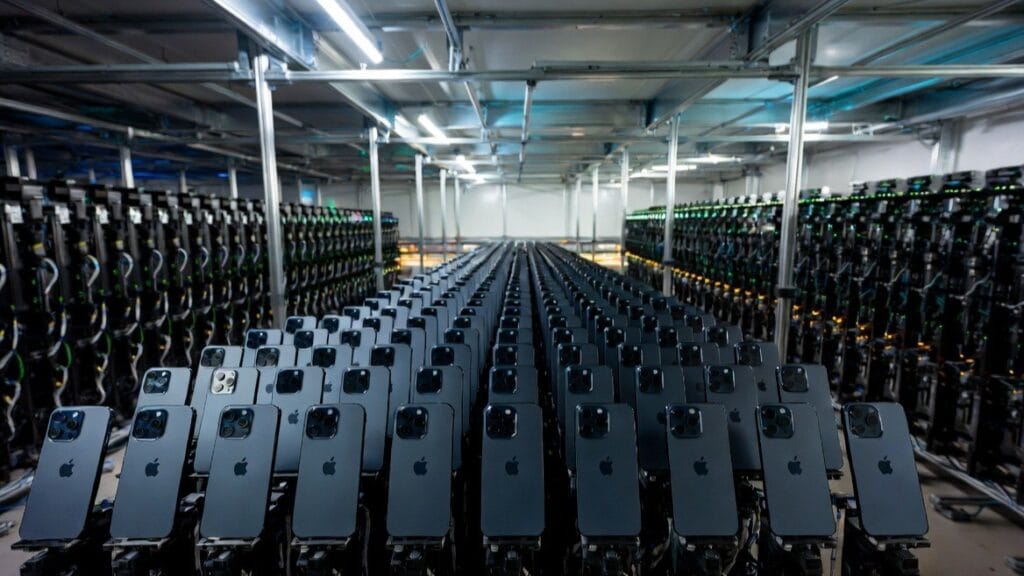
Server racks filled with iPhones in a 1MW data center thought experiment

How many iPhones? Under sustained heavy computational load, an iPhone 16 Pro Max draws roughly ~4 watts. That means 1,000,000W ÷ 4W = ~250,000 iPhones.

The A18 Pro chip has three compute engines.

GPU – ~4 TFLOPS (FP32) per device. 250,000 × 4 TFLOPS = 1 ExaFLOP – that’s exascale territory, matching the world’s most powerful supercomputers.

Neural Engine – 35 TOPS (INT8) per device. 250,000 × 35 TOPS = 8.75 PetaOPS for AI/ML inference workloads.

CPU – ~0.6 TFLOPS per device. 250,000 × 0.6 TFLOPS = ~150 PetaFLOPS.

Efficiency is actually impressive. The A18 Pro delivers roughly ~1 TFLOPS/W (GPU), while a data center-grade NVIDIA H100 GPU delivers ~0.1 TFLOPS/W (FP32). Mobile chips are extraordinarily power-efficient by comparison – they just can’t run continuously at peak without throttling.

Physical reality check: each iPhone 16 Pro Max is about 163 × 78 × 8.3 mm. 250,000 of them occupy roughly 26 cubic meters – filling only about 18 standard server racks physically, though cooling all those densely packed devices would be an engineering nightmare.

MetricValue
iPhones needed~250,000
GPU compute~1 ExaFLOP (FP32)
AI inference~8.75 PetaOPS (INT8)
Physical volume~26 m³ (~18 racks)
Cost (at ~$1,200/unit)~$300 million

The compute number is genuinely staggering – on paper it rivals Frontier, the world’s first exascale supercomputer – but of course real-world use would be limited by thermal throttling, interconnect bandwidth, and the fact that iPhones aren’t designed for sustained 100% load.

#DataCenters #AIInfrastructure #Compute #iPhone #HPC #EnergyEfficiency

https://www.linkedin.com/pulse/i-ran-numbers-you-filled-1mw-data-center-iphones-heres-gailitis-0rvtc

Related articles:

Be Among the First: Join the Launch of a Next-Generation AI Data Center in Riga

Key takeaways

  • Delska EU North Riga LV DC1 – a 10 MW facility expandable to 30 MW, designed for AI, HPC and sovereign digital infrastructure – opened on 15 April 2026 in Riga.
  • Up to 250 kW per rack with hybrid CoolWall air + liquid cooling, powered by 100% renewable energy.
  • Tier III design with 99.982% uptime and a 400G connectivity backbone across Europe.

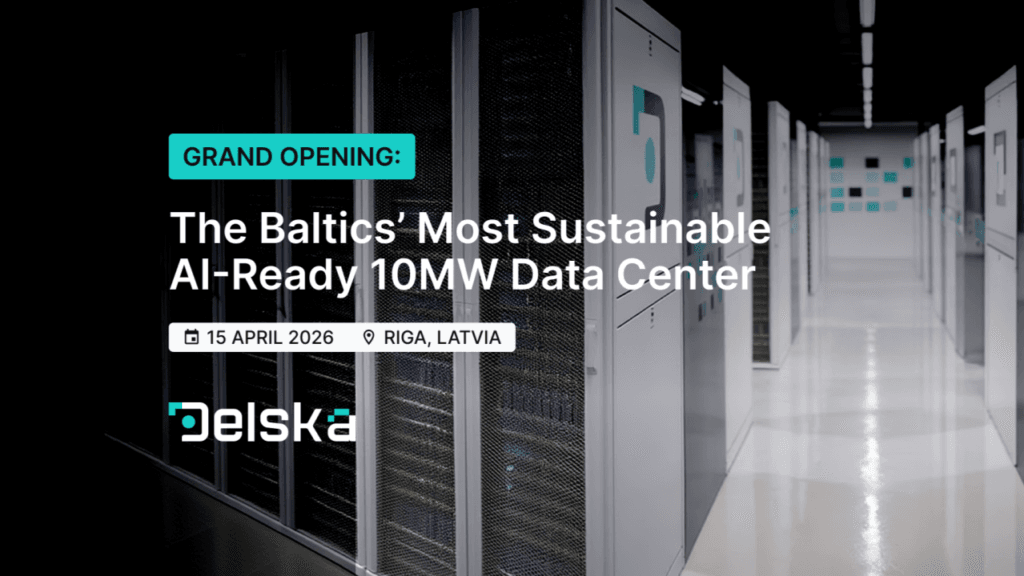
On April 15, 2026, we will unveil something that goes beyond a traditional data center. We are opening Delska EU North Riga LV DC1 – the most advanced and sustainable data center ever built in the Baltics. A 10 MW facility designed not for today’s workloads, but for what comes next: AI, HPC, and sovereign digital infrastructure in Northern Europe.

Delska EU North Riga LV DC1 - grand opening of the most sustainable AI-ready 10MW data center in the Baltics

This is a strategic milestone not only for Delska, but for the region.

To mark this launch, we are bringing together government representatives, global technology partners, and senior industry leaders to explore the future of compute, energy, and digital sovereignty.

📅 April 15, 2026
📍 Riga, Latvia · In-person & Live Stream (RSVP required)
👉 Register: delska.com/lvdc1-launch-event

EU North Riga LV DC1 is built with a clear promise: infrastructure must scale with ambition.

  • 10 MW capacity, expandable to 30 MW on secured land with reserved power
  • Up to 250 kW per rack to support AI and HPC workloads at scale
  • Hybrid cooling architecture combining CoolWall air and liquid cooling
  • Powered by 100% renewable energy from Northern Europe
  • Designed to Tier III standards with 99.982% uptime
  • 400G connectivity backbone with low-latency access across Europe

This is not just an improved data center. It is a platform for next-generation compute deployment.

The opening will take place in two parts.

Private Opening Ceremony (invitation-only | live streamed) – featuring government leaders and strategic partners, setting the tone for the region’s digital future.

Executive Program (RSVP required) – with contributions from Dell Technologies, Veeam, 11Stream, and Delska, alongside:

  • Forward-looking perspectives on AI infrastructure and sovereign compute
  • Exclusive guided access to the facility
  • High-value networking with the regional and international tech ecosystem

We also have opened reservation access for organizations planning their next phase of infrastructure growth. If you cannot attend our launch event but would like to tour the facility on a private visit, please drop us a message – sales@delska.com.

👉 Pre-book your capacity: delska.com/data-centers/eu-north-riga-lv-dc1

Facilities like this are not built often. And access at this stage is even rarer.

If you are shaping infrastructure strategy for the coming years – this is where the conversation starts. Welcome!

#AIInfrastructure #DataCenters #SovereignCompute #GreenEnergy #Baltics #DigitalTransformation

https://www.linkedin.com/pulse/among-first-join-launch-next-generation-ai-data-center-gailitis-aroof

Related articles:

Digital Progress — Or Digital Dependence?

Key takeaways

  • Society increasingly depends on digital systems that must work 100% of the time – and centralization into a few hyperscale hubs makes failures more severe.
  • Data centers are now critical national infrastructure, as important as energy grids or transportation.
  • Regional and national data centers are a resilience strategy: digital services must survive even if larger global systems fail.
  • Digital infrastructure should be treated like energy security – a national priority, not a convenience.

The last decade of technological development sometimes feels like something straight out of science fiction – stories about powerful computers, intelligent machines, and systems quietly running the world behind the scenes.

Digital Progress — Or Digital Dependence?

Except reality isn’t nearly as glamorous.

I’ve always been a strong believer in technology and innovation. The digital economy has created extraordinary tools, services, and opportunities. But every now and then it’s worth pausing and asking a more uncomfortable question: are we actually becoming more vulnerable?

Despite all the technological progress, our society increasingly depends on systems that must work 100% of the time. When they do – everything feels seamless. But when they stop, the consequences can be far more severe than in the past.

One of the biggest risks is centralization.

Massive digital platforms and hyperscale infrastructure have concentrated enormous amounts of computing power and data into relatively few locations. At the same time, true privacy is slowly disappearing as our lives become fully digitized.

Data centers are no longer just IT infrastructure. They have become critical national infrastructure – as important as energy grids or transportation systems.

And this changes how we should think about them.

Instead of relying solely on a few global hyperscale hubs, countries should be investing in regional and national data centers that allow digital services to remain operational even if larger global systems fail.

Geographic distribution is no longer just an engineering preference – it is a resilience strategy.

From a geopolitical perspective, major digital infrastructure sites can quickly become primary targets during crises or conflicts. That means governments, companies, and infrastructure providers must invest more into redundancy, security, and distributed architecture.

Of course, this comes at a price.

More resilience means more infrastructure. More infrastructure means more protection. And ultimately, higher costs for digital services.

So the real question might not be whether technology is advancing – because it clearly is.

The real question is:

Are we building a stronger digital world, or simply a more fragile one that requires constant protection?

As a data center infrastructure provider, I strongly believe that regional digital infrastructure matters more than ever. Countries should not rely solely on a few global hyperscale centers. Digital independence requires local capacity, distributed architecture, and strategic resilience.

Maybe it’s time to start thinking about digital infrastructure the same way we think about energy security.

Not as a convenience.

But as a national priority.

And perhaps this is the question we should all start asking ourselves.

Subscribe & Share now if you are building, operating, and investing in the digital infrastructure of tomorrow.

#datacenters #digitalinfrastructure #cybersecurity #geopolitics #cloudcomputing #digitalsovreignty #datacenterindustry #criticalinfrastructure #techstrategy #futureoftechnology

https://www.linkedin.com/pulse/digital-progress-dependence-andris-gailitis-2oetf

Related articles:

The future of AI computing is blasting off into orbit!

Key takeaways

  • In November 2025, Starcloud-1 trained AI models in orbit on an NVIDIA H100 – the first AI model training in space.
  • Orbital data centers promise near-constant solar power (up to 8x more effective than ground panels), zero water cooling and unlimited scalability.
  • Starcloud, Aetherflux, SpaceX, Blue Origin, Google and Europe’s ASCEND project are all racing toward orbital compute.
  • Main challenges – deployable radiators, radiation hardening, latency and launch costs – are falling fast.

As explosive AI growth pushes terrestrial data centers to their limits – devouring massive electricity, guzzling billions of gallons of water for cooling, facing land shortages, permitting delays, and grid overloads – a revolutionary alternative is emerging: orbital data centers.What once sounded like pure sci-fi is now reality. Just last month (November 2025), Nvidia-backed startup Starcloud (formerly Lumen Orbit) launched Starcloud-1, a compact satellite carrying a full Nvidia H100 GPU – 100x more powerful than any prior space compute hardware.And it worked spectacularly: In orbit, they successfully trained and ran multiple AI models, including Andrej Karpathy’s NanoGPT on the complete works of Shakespeare, and Google’s open-source Gemma LLM. This marks the first-ever AI model training in space, proving data-center-class GPUs can thrive in orbit.The advantages are mind-blowing:

The current image has no alternative text. The file name is: Screenshot-2025-12-13-at-11.23.49.png
  • Near-constant solar power: In optimized sun-synchronous orbits, satellites get up to 8x more effective energy than ground panels, with no night cycles or weather interruptions.
  • Zero water cooling: Waste heat radiates directly into the cold vacuum of space – no evaporation towers, no freshwater strain.
  • Unlimited scalability: No land acquisition, no local opposition, no grid upgrades needed.
  • Potentially 10x lower long-term costs: Even factoring launches, abundant clean energy and passive cooling slash operational expenses.
  • Sustainability boost: Orbital facilities could dramatically cut AI’s carbon footprint while preserving Earth’s precious resources.

The momentum is unstoppable. Major players are racing ahead:

  • Starcloud plans clusters with multiple H100s and Nvidia’s next-gen Blackwell GPUs in 2026–2027, targeting commercial workloads like satellite imagery inference for disaster response.
  • Aetherflux unveiled “Galactic Brain” – aiming for the first commercial orbital AI node in Q1 2027, leveraging space solar for unrestricted compute.
  • SpaceX (via Elon Musk) is adapting high-power Starlink V3 satellites for AI processing, with massive deployment potential via Starship.
  • Blue Origin has been quietly developing orbital data center tech for over a year.
  • Google’s Project Suncatcher explores solar-powered AI satellite constellations.
  • Axiom Space launching orbital data nodes soon.
  • Europe’s ASCEND project (led by Thales Alenia Space) confirmed feasibility for gigawatt-scale by mid-century.

Of course, real engineering challenges exist. Cooling dense racks demands large deployable radiators (governed by Stefan-Boltzmann radiation physics), radiation hardening for reliable operation, occasional latency for ground links, and upfront launch costs. But plummeting reusable rocket prices (thanks to Starship), innovative lightweight radiators, and proven demos like Starcloud-1 are rapidly closing those gaps.We’re witnessing the dawn of a new era: Abundant, green, scalable compute powering the AI revolution without burdening our planet. Orbital data centers aren’t just hype – they’re the sustainable path forward.What excites you most about this frontier? Will space host the world’s largest AI factories by 2040? Drop your thoughts below!

Subscribe & Share now if you are building, operating, and investing in the digital infrastructure of tomorrow.

#AI #SpaceTech #Innovation #ArtificialIntelligence #Sustainability #FutureOfComputing #OrbitalDataCenters #SpaceAI #AIRevolution #SustainableTech #TechInnovation #DeepTech

https://www.linkedin.com/pulse/future-ai-computing-blasting-off-orbit-andris-gailitis-c2ewf

Related articles:

Data Centres: From Tenants to Titans

Key takeaways

  • The balance of power has flipped: developers and operators, not hyperscalers, now hold the upper hand – the real scarcity is power and land.
  • US data centre rents rose from about $120/kW/month in 2021 to nearly $190 by 2024 – scarcity economics, not inflation.
  • 10-, 15- and 20-year contracts are the norm again, making data centres look and finance like traditional infrastructure.
  • The model is shifting from multi-tenant colocation to single-tenant mega-campuses of hundreds of megawatts.

Five years ago, few imagined that data centres — those humming, power-hungry fortresses of servers — would become one of the most coveted infrastructure assets on the planet.

Data Centres: From Tenants to Titans

But that’s exactly what has happened.

The balance of power has flipped. Once, hyperscalers like AWS, Google, and Microsoft dictated lease terms and pricing. Today, it’s the developers and operators holding the upper hand — because the real scarcity isn’t capital anymore. It’s power and land.


💡 The Golden Ticket

A leading infrastructure investor recently called power access “a golden ticket” — and it’s hard to disagree.

In the age of AI and hyperscale cloud growth, a secured grid connection is everything. You can raise billions and hire world-class engineers — but if you can’t plug into the grid, you can’t scale.

The numbers tell the story. In 2021, U.S. data centre rents averaged around $120 per kW per month. By 2024, that figure climbed over 50%, nearing $190 per kW. London saw similar jumps. This isn’t inflation — it’s scarcity economics.

Those who control powered land now hold the real bargaining power.


🧭 From Hyperscaler Leverage to Developer Control

For years, hyperscalers pushed for short 5- to 7-year contracts and flexible termination rights. They called the shots.

Not anymore.

Tight grid capacity and exploding AI demand have turned the tables. Tenants who once wanted short leases are now regretting it — there’s simply no capacity left, and renewals cost far more.

Today, 10-, 15-, and even 20-year contracts are the norm again. Banks and institutional lenders love it: predictable cash flows, long-dated contracts, and high-credit counterparties. Data centres are starting to look, feel, and finance like traditional infrastructure.


🏗️ From Colocation to Mega-Campuses

The model has evolved dramatically. What used to be multi-tenant colocation sites is becoming a network of massive, single-tenant campuses — hundreds of megawatts each — built around one hyperscaler.

That shift allows developers to recover rising capex costs tied to liquid cooling, AI training, and high-density workloads. Interestingly, many hyperscalers are now co-funding upgrades, treating them as tenant improvements, just like in commercial real estate.

It’s a more mature, symbiotic model — one that aligns incentives and strengthens partnerships.


🤝 Creative Structures and Shared Risk

Deal structures are also becoming more sophisticated.

When Meta financed its $26 billion data centre campus in Louisiana, the project reportedly included a “residual value guarantee.” In other words, if Meta exited early and the asset value dropped, investors would be compensated.

A few years ago, such clauses were rare. Now they’re becoming standard as both sides seek to balance long-term risk and reward.

Developers are also designing hybrid facilities — capable of switching between air and liquid cooling — and adopting flexible layouts that can evolve with technology. As Brookfield’s Sikander Rashid noted, “A chip’s useful life is about five years — your return on capital should match that.”


🏦 Core Capital Enters the Game

Not long ago, core and core-plus funds avoided data centres, seeing them as too technology-driven. That’s changing fast.

Brookfield, Arjun Infrastructure Partners, and Interogo recently invested in a €3.6 billion European data centre portfolio with 12-year average contracts and inflation-linked escalators — exactly the type of structure core infrastructure funds love.

One industry insider summed it up perfectly:

“If you’ve got powered land near population centres, your barrier to entry is the grid connection itself.”

In other words: the moat isn’t a brand or a logo — it’s megawatts.


⚙️ The Moat Built on Megawatts

Every road in this story leads back to power.

If forecasts hold true, most major data centre hubs will hit grid constraints within a decade. That physical bottleneck — not capital — will define value.

It’s why long-term leases are back. It’s why banks are lending more confidently. And it’s why investors view data centres as durable, inflation-protected infrastructure.

Operators like DigitalBridge are also moving to triple-net leases, where tenants manage their own power and cooling systems. That shift drives efficiency and attracts even more institutional capital.


🌍 The Future: Flexible, Long-Term, and Infra-Grade

So, are data centres infrastructure? The debate is over.

They’ve earned their place alongside utilities, ports, and energy assets — long-term contracts, critical grid dependence, and predictable returns.

But beyond the financials lies a bigger truth: the digital economy runs on electrons and geography. Whoever controls the megawatts controls the growth.

AI will only intensify this. The next generation of winners will be those who think like infrastructure investors but move like tech builders — fast, flexible, and focused on power resilience.

The moat is no longer theoretical. It’s physical. It’s grid-connected. And it’s here to stay.


✍️ The digital economy’s backbone isn’t code — it’s concrete, copper, and current. The investors who understand that first will shape the next decade of infrastructure.

Subscribe & Share now if you are building, operating, and investing in the digital infrastructure of tomorrow.

#DataCentres #InfrastructureInvesting #AIInfrastructure #DigitalTransformation #Sustainability #EnergyTransition #RealAssets #PrivateEquity #InfraFunds #Hyperscale #CloudComputing #PowerMarkets #GridCapacity #DataEconomy #LongTermCapital

https://www.linkedin.com/pulse/data-centres-from-tenants-titans-andris-gailitis-qjobf

Related articles:

Mind the Gap: Closing the Expectation Divide in Cloud & Data Center Services

Key takeaways

  • 99.95% uptime sounds excellent but still allows almost 4.5 hours of downtime a year – and customers only notice the failures.
  • Standard cloud and bare-metal contracts cover infrastructure access, not data protection: if backups are not in the contract, there is nothing to restore.
  • A backup stored on the same server is not a backup – real resilience requires offsite storage or separate physical infrastructure.

Global demand in cloud computing industry and data centers is growing faster than ever. There is an explosion of hyperscalers as well as AI workloads that provide unprecedented growth impetus; companies at every level depend on providers to maintain high-performance networks. Yet amid all its innovation and growth, though, one thing is unchanged: the difference between what service agreements promise and what customers expect.

Uptime: The One-Way Street of Gratitude

The majority of professional hosting and cloud agreements make an uptime priority minimum (generally 99.95% and up) for essential network and infrastructure. 99.95% is perfect for the average joe, but in practice it allows for almost 4½ hours of downtime a year. Here’s the paradox: if a provider provides flawless service for years, no one writes a thank-you note. The silence on success is just “business as usual.” But then for 5 minutes when a blip happens … still well under 99.95% of the promise … customer support lines light up and legal clauses get quoted back to the provider. It’s not the case of customers being ungrateful, the lesson is that reliability has been rendered invisible. Uptime is required, and any deviation, no matter how slight or contractually permissible, is regrettable.

Backups: The Unpaid — and Often Misplaced — Safety Net

And the other consistent rub is backup accountability. Many customers of the cloud and bare-metal world think data can be automatically backed up when it resides at a professional data center. In practice, much of the standard agreement does not provide protection for data but access to the essential infrastructure. When a virtual machine fails or a dedicated server’s disk dies, infrequent but inevitable events, customers without a backup plan often require that the provider “just recover it.” And unless backups were part of the contract (or bought as an add-on), the provider can’t magically restore lost data. Another common yet sometimes ignored rule: You don’t have backup and recovery if you don’t pay for them. Customers can and should be told and are supposed to be educated by providers, but the responsibility of protecting data integrity falls to the data owner.

Backups on the Same Server: A Concealable Catch

Even customers who maintain backups can fall into the trap of storing those backups on the same VM or dedicated server they’re trying to protect. When the underlying hardware fails, it means that both the live data and the “backup” could disappear in a single stroke. Real resilience is holding backups offsite or at least on different physical infrastructure — in another availability zone, on another storage platform or through a managed backup service. A backup that shares the same failure domain isn’t a backup at all; it is simply yet another copy waiting to fail.

Planned Maintenance: No Good Deed Goes Unpunished

Even infrastructure most reliably established requires care. Hardware firmware ought to be patched, network gadgets upgraded, and security equipment put to the latest security updates. Nearly every service agreement specifies the timing of scheduled maintenance windows, and providers generally work on those days in the dead of night with ample notice given. Yet maintenance notices regularly provoke resistance. Some customers need zero disruption at any cost, including when the work is needed to prevent future outages. Ironically, the clients who value stability can be hostile to the very processes needed to preserve it.

Bridging the Expectation Gap

So how do providers and customers come together in the middle?

Crystal-Clear SLAs

Service Level Agreements need to be written in plain language, specifying uptime objectives, response times, and — crucially — what is not included. Define roles for backups, recovery and data retention.

Proactive Education

Providers should communicate the reality of uptime %, needs for maintenance, and responsibilities for backups during the sales process, not after the fact.

Shared Responsibility Models

When you hear the term shared responsibility, public cloud behemoths such as AWS and Azure made it famous. The former way, (whether that be infrastructure-as-a-service (IaaS) or colocation), is that the provider maintains the platform, while the customer secures and backs up their data.

Celebrate Reliability

It might seem a little self-obsessed, but frequently appearing as reports of “X days of uninterrupted service” help remind subscribers of what they’re getting back — and can help soften feelings when an unavoidable event plays out.

Not a Transaction, a Partnership

A data-center / cloud agreement is a partnership in its simplest form. Providers agree to world-class uptime, redundancy, and security; clients agree to gauge the extent of those services and plan. And when each side sees the contract as a living document and not fine print, there’s less room for surprise and fewer panicking calls when the inevitable hiccup occurs.

Takeaway: That is, nothing about the world-defining infrastructure is ever “set and forget.” Transparency is the key to successful customer relationships: explicit SLAs, contracts of mutual responsibilities, and an understanding that when it comes to maintenance, backups (carried out in their own locations) and periodic downtime, the system is better for it. Finally, a strong provider is not someone who never does need to worry about a problem, but one who talks things over openly, keeps promises and works with customers to navigate the times when the lights go out.

#CloudComputing #DataCenters #SLA #Uptime #Downtime #CloudServices #Infrastructure #DevOps #ITOperations #ServiceLevelAgreement #HighAvailability #CloudReliability #CloudBackup #PlannedMaintenance #BusinessContinuity

https://www.linkedin.com/pulse/mind-gap-closing-expectation-divide-cloud-data-center-andris-gailitis-wo94f

Related articles:

Proudly powered by WordPress | Theme: Baskerville 2 by Anders Noren.

Up ↑