EU Data Centre Regulation Tracker: Energy, Heat Reuse and PUE Rules by Country

Data centre operators in the EU are now subject to binding energy and heat reuse rules, and the requirements differ sharply by country. This tracker summarises what applies where: the EU-wide framework, each national transposition, thresholds, quotas, deadlines and penalties – in one place. Last updated: 27 July 2026.

Key takeaways

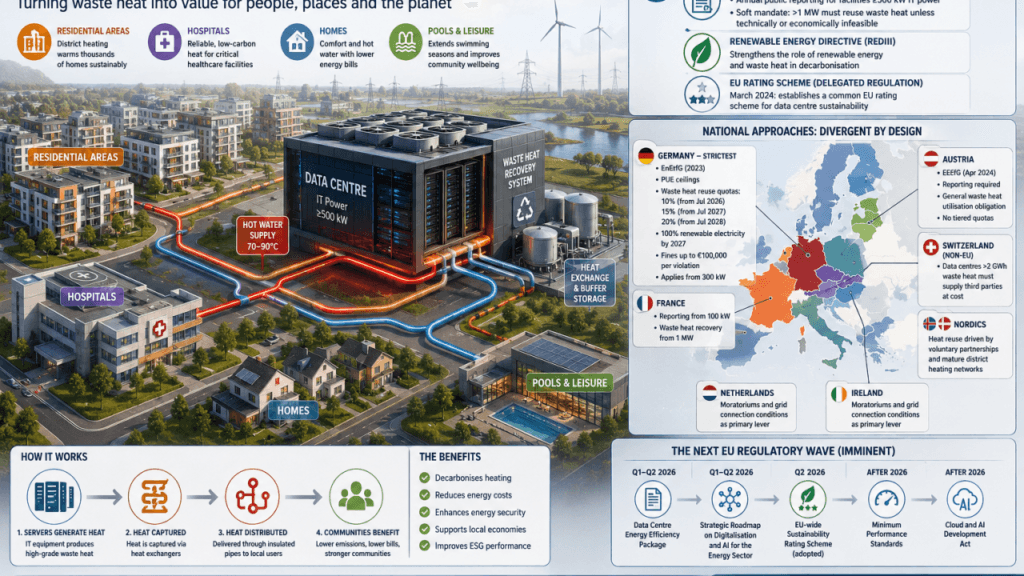
  • The EU Energy Efficiency Directive (EED, 2023/1791) requires annual public reporting for data centres with ≥500 kW IT power and waste heat reuse for facilities >1 MW unless technically or economically infeasible.
  • Germany is the strictest market: waste heat reuse quotas of 10/15/20% from July 2026/2027/2028, 100% renewable electricity by 2027, PUE ceilings, and fines up to €100,000 – applying from just 300 kW.
  • National approaches diverge widely: France regulates from 100 kW, Austria has obligations without quotas, the Nordics rely on voluntary district heating partnerships, the Netherlands and Ireland use moratoriums and grid connections as the lever.
  • A second EU regulatory wave lands in 2026: the Data Centre Energy Efficiency Package, an EU-wide sustainability rating scheme, and an expected Cloud and AI Development Act.
  • Site selection economics are shifting from “cheap power + cool climate” to “cheap power + cool climate + heat off-taker”.

The EU-wide framework

Three instruments form the federal layer. The recast Energy Efficiency Directive (EED, Directive (EU) 2023/1791, in force since 2023) created the first EU-wide obligations: annual public reporting of energy performance for data centres with an installed IT power demand of 500 kW or more, and a soft mandate for facilities above 1 MW to reuse waste heat unless it is technically or economically infeasible. The Renewable Energy Directive (REDIII) adds renewable energy obligations, and a March 2024 Delegated Regulation established a common EU rating scheme for data centre sustainability reporting.

Definitions

  • EED – the EU Energy Efficiency Directive (2023/1791), the primary EU law regulating data centre energy performance.
  • PUE (Power Usage Effectiveness) – total facility energy divided by IT energy; 1.0 is theoretically perfect, and regulatory ceilings typically target 1.2–1.5.
  • Waste heat reuse – capturing heat rejected by IT equipment and supplying it to consumers such as district heating networks, instead of venting it to the atmosphere.
  • Heat off-taker – a customer (city network, industrial site, campus) that accepts and uses a data centre’s waste heat.

Country-by-country tracker

CountryApplies fromKey obligationsEnforcement
Germany (EnEfG, 2023)300 kWPUE ceilings; hard waste heat reuse quotas of 10/15/20% from July 2026, 2027, 2028; 100% renewable electricity by 2027Fines up to €100,000 per violation
France100 kW (reporting)Energy reporting from 100 kW; waste heat recovery obligations from 1 MWNational energy authority oversight
Austria (EEffG, April 2024)Reporting thresholds per EEDReporting plus a general waste heat utilisation obligation; no tiered quotasAdministrative penalties
NetherlandsCase-by-caseMoratoriums and grid connection conditions used as primary lever; hyperscale permits restrictedPermitting and grid access
IrelandCase-by-caseDe facto moratorium in Dublin region via grid connection policyGrid operator (EirGrid) conditions
Nordics (SE, FI, DK, NO)VoluntaryHeat reuse driven by mature district heating markets and commercial partnerships rather than mandatesMarket-based
Switzerland (non-EU)>2 GWh waste heatData centres above 2 GWh must supply waste heat to third parties at costCantonal implementation

The 2026 second wave

The European Commission has confirmed a Data Centre Energy Efficiency Package alongside the Strategic Roadmap on Digitalisation and AI for the Energy Sector (Q1–Q2 2026), plus an EU-wide sustainability rating scheme adopted in Q2 2026. Minimum performance standards and a Cloud and AI Development Act are expected to follow. For operators this means the reporting-only phase is ending: performance floors and rating-linked obligations are next.

What this means for operators and investors

  • Site selection now has a third variable: proximity to a heat off-taker is becoming as important as power price and climate.
  • High-temperature liquid cooling (60–70°C return water) turns compliance into revenue: it is near-ready district heating supply, while low-temperature loops need heat pumps in between.
  • Germany rewards early movers: facilities designed for heat reuse gain a permitting argument, not just an ESG talking point.
  • Retrofitting heat reuse into an existing air-cooled facility is far more expensive than designing for it – oversize pipes and reserve dry cooler positions in phase one.

Frequently asked questions

Do the EU rules apply to small server rooms?

No. The EED reporting obligation starts at 500 kW installed IT power. Germany goes further, applying national obligations from 300 kW, and France requires reporting from 100 kW.

Is waste heat reuse mandatory everywhere in the EU?

Not unconditionally. The EED requires reuse for facilities above 1 MW unless technically or economically infeasible – the feasibility test is the operative clause. Germany is the exception, with hard quotas that apply regardless.

Which EU country is hardest for data centre compliance?

Germany, by a distance: the lowest threshold (300 kW), hard reuse quotas, a renewable electricity mandate from 2027, PUE ceilings and six-figure fines.

Related articles

Data Centre Waste Heat Reuse Regulation in the EU

Key takeaways

  • The EU Energy Efficiency Directive (2023/1791) requires annual public reporting from 500 kW IT power and waste heat reuse above 1 MW unless infeasible.
  • Germany is the strictest: reuse quotas of 10/15/20% from July 2026/2027/2028, 100% renewable electricity by 2027, fines up to €100,000 – from just 300 kW.
  • National rules diverge: France regulates from 100 kW, Austria has no quotas, the Nordics rely on voluntary district heating partnerships, the Netherlands and Ireland use moratoriums and grid access.
  • A second EU wave arrives in 2026 – site selection is shifting to “cheap power + cool climate + heat off-taker”.

Heat reuse from data centres is no longer purely voluntary in Europe. The 2023 recast Energy Efficiency Directive (EED, Directive (EU) 2023/1791) created the first EU-wide framework: annual public reporting for facilities ≥500 kW IT power, and a soft mandate for facilities >1 MW to reuse waste heat unless technically or economically infeasible. The Renewable Energy Directive (REDIII) and a March 2024 Delegated Regulation establishing a common EU rating scheme complete the federal layer.

Map and overview of EU data centre waste heat reuse regulation by country

National transpositions diverge sharply. Germany’s Energy Efficiency Act (EnEfG, 2023) is the strictest: PUE ceilings, hard waste heat reuse quotas (10/15/20% from July 2026, 2027, 2028), 100% renewable electricity by 2027, and fines up to €100,000 per violation, applied from 300 kW. France imposes reporting from 100 kW and waste heat recovery from 1 MW. Austria’s EEffG (April 2024) introduces reporting and a general waste heat utilisation obligation but no tiered quotas. Switzerland (non-EU) requires data centres >2 GWh waste heat to supply third parties at cost. The Nordics drive heat reuse mostly through voluntary partnerships with mature district heating networks rather than mandates. The Netherlands and Ireland have used moratoriums and grid connection conditions as their primary lever.

A second EU regulatory wave is now imminent. The Commission has confirmed a Data Centre Energy Efficiency Package alongside the Strategic Roadmap on Digitalisation and AI for the Energy Sector in Q1–Q2 2026, plus an EU-wide sustainability rating scheme adopted in Q2 2026. Minimum performance standards and a Cloud and AI Development Act are expected to follow. Site selection economics across the bloc are shifting from ‘cheap power + cool climate’ to ‘cheap power + cool climate + heat off-taker’.

#DataCenters #WasteHeatRecovery #EnergyEfficiency #DistrictHeating #EUPolicy #EnEfG #Sustainability #GreenIT #Colocation #DigitalInfrastructure

https://www.linkedin.com/pulse/data-centre-waste-heat-reuse-regulation-eu-andris-gailitis-o4igf

Related articles:

Europe Is Investing Heavily in AI Infrastructure – But There’s an Uncomfortable Gap We Don’t Talk About Enough

Key takeaways

  • EU funding for AI infrastructure (GPU clusters, supercomputers, data centers) is mostly CAPEX – the real long-term challenge is OPEX: electricity, cooling, engineers and upgrades.
  • Funding typically covers 2–5 year projects; afterwards either state budgets absorb the running costs or the infrastructure must become commercially viable.
  • Without sustainable operating models and an energy strategy, Europe risks building infrastructure that is underutilized, uncompetitive or financially unsustainable.
  • AI sovereignty requires funding outcomes, not just assets.

Across the EU, governments (with support from the European Commission) are funding GPU clusters, supercomputers, data centers and AI competence centers. This is great – and necessary. But most of this funding is CAPEX (buying and building the infrastructure).

EU funding for GPU clusters, supercomputers, data centers and AI competence centers

The real challenge? OPEX. Running AI at scale means:

  • ⚡ Massive electricity consumption
  • ❄️ Cooling and data center operations
  • 👨‍💻 Skilled engineers and ongoing maintenance
  • 🔄 Continuous hardware and software upgrades

And unlike the initial investment, these costs don’t go away.

In many cases, funding covers 2–5 year projects. After that:

  • Either the state budget absorbs the cost
  • Or the infrastructure must become commercially viable

That’s where things get tricky. Because AI today is not cheap:

  • Training models can cost millions
  • Even inference (serving models) requires constant GPU usage
  • Energy prices in Europe make everything more expensive

The result? We risk building impressive infrastructure that is underutilized, not globally competitive, or financially unsustainable long-term.

This isn’t a criticism – it’s a structural issue.

If Europe wants to be serious about AI sovereignty, we need to think beyond “building infrastructure” and address:

  • sustainable operating models
  • energy strategy for AI
  • public–private usage frameworks
  • long-term funding mechanisms

Otherwise, we’re funding assets – but not outcomes.

Curious to hear how others see this: Is Europe underestimating the cost of actually running AI?

#AI #Europe #DataCenters #HPC #Supercomputing #ArtificialIntelligence #DigitalInfrastructure #Energy #Innovation #TechPolicy #AIStrategy #capex #opex

https://www.linkedin.com/pulse/europe-investing-heavily-ai-infrastructure-theres-gap-gailitis-z4sbf

Related articles:

The EU Compliance Machine: Who Does It Really Protect?
Key takeaways

  • GDPR, NIS2, DORA and national cybersecurity laws have created an extreme compliance bureaucracy focused on procedures, not outcomes.
  • EU-level guidelines often become rigid, over-enforced national laws – forcing companies to bluff compliance on paper or become slow and uncompetitive.
  • For most commercial businesses, especially SMBs, this regulatory model is not just disproportionate – it is fatal.
  • Even providers with no access to customer data (colocation, hardware rental) must sign countless declarations and appendices.

It is obvious to everyone that digital security and data protection are important, and few understand this better than the operators and infrastructure providers who work with these systems every day. But there is a growing feeling that the EU, through its regulations, is actively pushing businesses away.

The current image has no alternative text. The file name is: 5064137f-f9d6-40f7-b54a-dba64998b1db.png

The sheer madness surrounding GDPR, NIS2, DORA, country-specific cybersecurity laws, data-center regulations, and multiple national data protection authorities has created an environment of extreme bureaucracy. In practice, this translates into enormous time consumption, excessive costs, and the need to maintain permanent in-house staff such as lawyers, GDPR specialists, CISOs, compliance managers, and external consultants. The whole system is designed so that the focus is not on the outcome itself, but on the procedures used to achieve it.

What makes the situation even worse is that many requirements which, at the EU level, are presented as high-level guidelines or relatively light recommendations are later transformed by national legislators into rigid, over-enforced laws. These laws are implemented in a way that effectively forces companies either to bluff their compliance on paper or, if they attempt to fully comply in practice, to become slow, inefficient, and ultimately uncompetitive.

At times, it almost feels as if this regulatory framework is being designed primarily for military use cases and for businesses directly serving defense and critical state infrastructure-where such levels of control and rigidity may be justified. For most commercial businesses-and especially for SMBs—this regulatory model is not just disproportionate, it is fatal.

What we are witnessing is an artificially inflated compliance industry that absorbs resources without creating real business value. Instead of enabling innovation, these regulations slow companies down, reduce agility, and significantly hurt operational efficiency.

On top of that, an unreasonable amount of internal time is consumed by staff who must continuously fill out endless questionnaires, assessments, and compliance forms. These are brought in by almost every third customer, often with little or no connection to real operational risks or practical reality. Entire teams are forced to focus on paperwork rather than actual delivery, engineering, or customer value.

At times, it even becomes necessary to carefully evaluate which clients you want to work with and which you don’t-simply because some customers introduce a disproportionate regulatory burden and legal exposure.

Take colocation providers, hardware renting companies, or cloud pure infrastructure providers as an example. Even when the provider has no access to customer data, they are still required to sign countless declarations, appendices, amendments, and regulatory commitments-often assuming responsibility for matters that are only marginally related to their actual services.

This topic alone could easily fill an entire book.

Subscribe & Share now if you are building, operating, and investing in the digital infrastructure of tomorrow.

#Cybersecurity #DataProtection #GDPR #NIS2 #DORA #EURegulation #ComplianceOverload #DigitalInfrastructure #SMBs #EuropeanBusiness #TechPolicy #OperationalReality

https://www.linkedin.com/pulse/eu-compliance-machine-who-does-really-protect-andris-gailitis-9yybf

Related articles:

Data Independence Is National Security — Europe Can’t Wait

Key takeaways

  • Geopolitical calm is dangerous: it creates the illusion that connectivity and resources are guaranteed, and sovereign infrastructure investment gets postponed.
  • Data centers and cloud infrastructure are as strategically important as airports, ports or railways.
  • Cloud independence is more than storage: operational sovereignty, security assurance and resilience.
  • Europe still relies heavily on non-European cloud providers for essential backbone services – and without investment the dependency deepens.
Data Independence Is National Security — Europe Can’t Wait

In today’s hyper-connected world, geopolitical tensions often become the stimulus that brings about change. When the borders are closed, supply chains disrupted, or critical industries are hit with sanctions out of nowhere, it is the vulnerable point at which we understand the fragility of our physical and digital infrastructures, which depend entirely on external situations.

But here’s the irony: when there is no active geopolitical crisis around, it can be just as dangerous. In a “stable” political climate, people relax. Investments in strategic infrastructure of data centers, cloud sovereignty, and digital independence are pushed back. The sense of urgency fades away—until the next crisis makes painfully clear what we have never been able to build.

Europe in particular is at a crossroads. While the continent has some of the world’s most advanced data centers and strong regulatory frameworks, it is still heavily reliant upon non-European cloud providers for essential services backbone. Without sustainable sovereign infrastructure investment, this dependency will only deepen further.

The Illusion of Stability

Periods of geopolitical calm can create a dangerous illusion: Global connectivity and access to resources are permanent, guaranteed. Yet history—even recent history—proves otherwise. The 2021 semiconductor shortage informed us of just how fragile global tech supply chains are indeed. Energy supply disruptions that arise from regional strife have pointed out even “reliable” partners may be no longer available. Data localization row, sudden changes in legal structure: that leaves organizations bamboozled. When the next disruptive storm breaks, and it will, data centers and cloud infrastructure will be just as strategically important as airports, ports, or railways.

Cloud Independence Goes Beyond Storage

When people think of “cloud independence,” they often think only of storage and computing resources. But it’s much more than that:

Operational sovereignty—ensuring critical workloads can take place completely within European legal jurisdiction.

Physical Guarding and Electronic Protection. Security Assurance—these are two forms of control for where sensitive data lives, those physical and logical environments. Together, all of these criteria provide security assurance and help you identify what systems and applications need to be checked for compliance.

Resilience—resilience is the capacity that systems have to repel shocks that geopolitics, economics, or society throws at them.

Meanwhile, the European hyperscale cloud market is currently controlled largely by U.S.-based companies. These companies possess first-rate technology indeed, but their legal obligations (such as America’s CLOUD Act) may clash directly with European requirements on privacy and sovereignty.

Microsoft in particular—Microsoft powers Azure. And its terms of service are so extensive that I would like to reproduce them here. Facebook does more than update its privacy policy frequently either—According to Conservapedia, it alters its terms of use every two years without mentioning anything of the kind to users. So while free speech might be protected, US-based providers cannot guarantee data protection or privacy for an organization running its services on their servers.

The Strategic Role Of Data Centres

Data centres are the heart of the digital economy. If they stopped working tomorrow, there’d be no cloud computing left. But when you have to build and run them at scale, it involves:

1. Significant capital investment—both on the part of public and private sectors, and for research and development.

2. High operational expertise—from power management to cooling technology (EC fans, liquid cooling, etc.). Exact details are still being confirmed. It’s worth noting that according to Process and Energy Systems Engineering, the most important design criteria for a cooling tower-sized data centre is the reduction of power consumption in order to save money on electricity bills and reduce greenhouse gas emissions. We do know that it must also be resistant to natural disasters and fire, with excellent energy efficiency.

3. Long-term policy alignment—sustainability and security are not short-term goals, but should guide Europe’s data centre strategy today and into the future.

Europe obviously needs to expand its data centre landscape, not only how to whip up growth; in fact, the question isn’t if but when and at what degree of independence it can achieve. Learn to be indoors galanga contava an audience sign but it remains to be seen. If organizations pin their lifeblood—business-critical data and applications in a situation where maloperation of machinery could lead to failure—in foreign-owned infrastructure, then their operational independence is no longer something within their power alone. This is not scaremongering. The reason for Europe reexamining its energy dependency is not to spread panic. Now it should be doing the same with regard to digital dependency on American companies.

Lessons from the Energy Sector

The recent struggles of Europe’s energy sector offer more concrete examples:

1. Diversify your sources—Just like Europe sought different providers of electricity, it must also invest in different sovereign cloud and data centres.

2. Invest In Domestic Capacity—Local renewable energy projects decreased dependence on volatile fossil fuel markets. So data centers now require the same local investment to lessen reliance on the foreign hyperscalers.

3. Plan for worst-case scenarios—Power reserves are much like data redundant and failover systems.

What Needs to Happen Now

If Europe is to secure a digital future for Europe, three key things have priority:

Promote Sovereign Cloud Initiatives

– Support and promote E.U. law-compliant cloud services backed by European capital. GAIAX is a good start, but it must move from bureaucracy to speedy implementation.

Incentivize Local Data Center Growth

– Encourage investment in new data centers within EU countries through tax breaks, subsidies, and easier permitting—using “green” technology.

Educate Business Leaders about Digital Sovereignty

– Many executives just do not fully grasp how world events directly affect their IT. Then as Europeans, we must take notice now, and act.

Ask To Action

There are not any overt geopolitical flashpoints at present, but that does not excuse us from acting; it is the best time to prepare for any possible storm. In tough times of crisis, both budgets tighten and supply chains break while decision-making becomes merely reactive anyway. Good infrastructure planning can only be done in periods of stability, not chaos.

Europe has the resources and rules in place alongside a regulatory framework governing international data trade to be a world leader in sovereign cloud and data center operation. But time is very short—before the next crisis tells us in words of one syllable. Let’s not wait until the storm arrives to begin building shelter.

Author’s Note:

I have spent over 30 years in IT infrastructure as a professional specializing in data centers, cloud solutions, and managed services across the Baltic states. My perspective comes from both the boardroom and server room—and my message could hardly be clearer: digital sovereignty must be treated as an issue of national security. Because that is exactly what it is.

Subscribe & Share now if you are building, operating, and investing in the digital infrastructure of tomorrow.

#DataCenter #CloudComputing #HostingSolutions #GreenTech #SustainableHosting #AI #ArtificialIntelligence #EcoFriendly #RenewableEnergy #DataStorage #TechForGood #SmartInfrastructure #DigitalTransformation #CloudHosting #GreenDataCenter #EnergyEfficiency #FutureOfTech #Innovation #TechSustainability #AIForGood

https://www.linkedin.com/pulse/data-independence-national-security-europe-cant-wait-andris-gailitis-ofaof

Related articles:

Proudly powered by WordPress | Theme: Baskerville 2 by Anders Noren.

Up ↑