Liquid Cooling vs Air Cooling in Data Centers: The Real Economics

Liquid cooling is cheaper to operate than air cooling at scale for one dominant reason: every megawatt moved from air to liquid escapes the chiller – the most expensive component in the cooling chain. But air cooling never disappears entirely. This guide explains the real economics of the air/liquid split in an AI-era data center, based on our experience planning new builds at DELSKA.

Key takeaways

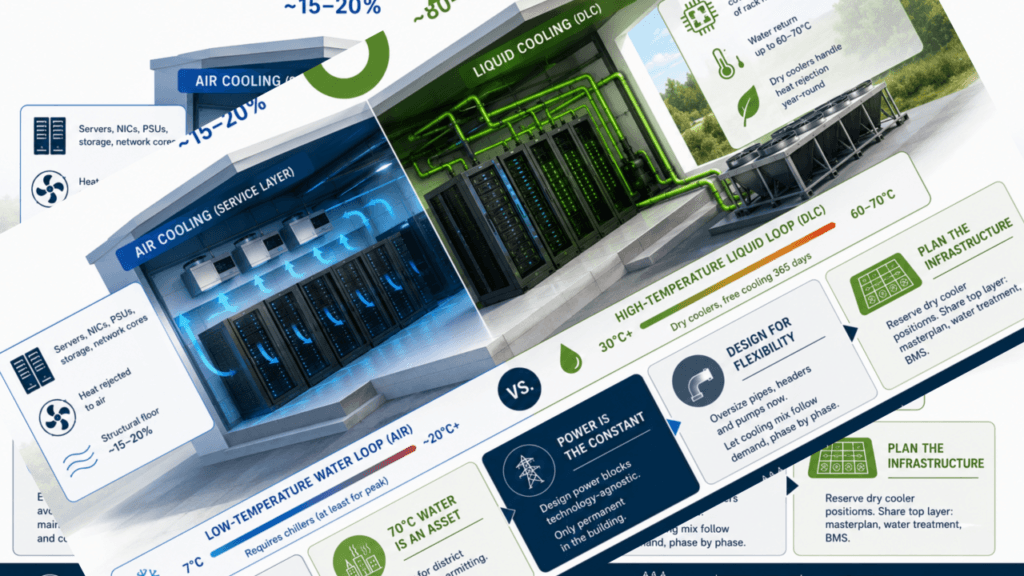
  • Direct-to-chip liquid cooling captures roughly 70–85% of rack heat; memory, NICs, power supplies and optics still reject to air, creating a structural floor of about 15–20% air cooling in any large deployment.
  • Air and liquid are different thermodynamic worlds: the air loop runs on low-temperature water (about 7°C to low-20s°C) and needs chillers; the high-temperature liquid loop returns water at 60–70°C and can reject heat with dry coolers alone, year-round, almost anywhere in Europe.
  • The “chiller tax” is the economic core: chillers carry the highest capex, maintenance, F-gas regulatory exposure and compressor energy – hitting PUE directly. Liquid megawatts do not pay it.
  • At 60–70°C, return water is near-ready district heating supply – in Germany a permitting argument and a potential revenue line under the Energy Efficiency Act.
  • Design conclusion: fix the power blocks, not the cooling ratio. Make power infrastructure technology-agnostic and let the cooling mix follow tenant demand.

Definitions

  • Direct-to-chip (DLC) liquid cooling – cold plates on CPUs/GPUs transfer heat to a liquid loop, removing the majority of rack heat without moving air.
  • Chiller – a compressor-based refrigeration machine producing chilled water for the air-cooling loop; the most expensive element of the chain in capex, maintenance and energy.
  • Dry cooler – a heat exchanger rejecting heat to ambient air without compressors or refrigerants; works alone when loop temperatures are high enough.
  • PUE (Power Usage Effectiveness) – total facility power divided by IT power; compressor energy is one of its biggest drivers.
  • Chiller tax – our shorthand for the combined capex, opex, F-gas exposure and PUE penalty that every air-cooled megawatt carries and liquid-cooled megawatts avoid.

Air vs liquid: the comparison

DimensionAir cooling loopHigh-temp liquid loop (DLC)
Working temperature~7°C to low-20s°C water60–70°C return water
Heat rejectionChillers required (at least for peak trimming)Dry coolers alone, 365 days, virtually anywhere in Europe
Compressors / refrigerantsYes – capex, maintenance, F-gas exposureNone
PUE impactCompressor energy hits PUE directlyMinimal mechanical cooling energy
Share of rack heat (AI hall)Structural floor of ~15–20%~70–85% via direct-to-chip
Heat reuse readinessNeeds heat pump upgrade to be usefulNear district-heating grade as-is
Scaling behaviourShare shrinks as facility growsShare grows with rack density

Why the air share shrinks as facilities scale

When we started planning our new builds we assumed roughly 20% air / 80% liquid. Then we noticed the larger the facility gets, the smaller the air percentage becomes – not by choice, but because physics and economics push it there. Every air-cooled megawatt pays the chiller tax; every liquid megawatt escapes it into dry cooler economics. At scale, that difference compounds.

And yet air never reaches zero. Even in a “fully liquid” AI hall, the residual heat from memory, NICs, power supplies and optics – plus network cores, storage and support infrastructure – lands at about 15–20% air. That is not a design choice. That is physics, at least until chip makers eliminate air-cooled components entirely.

Two loops, not one

One shared water system is not realistic: the loops live at completely different temperatures. What you can share is the top layer – the heat rejection field masterplan, water treatment, and BMS. The hydraulic circuits stay separate.

Waste heat: from cost to revenue

At high-temperature DLC return levels you are sitting on near-ready district heating supply. In Germany, where the Energy Efficiency Act requires heat reuse readiness for large data centers, 60–70°C return water stops being an ESG talking point and becomes a permitting argument – and potentially a revenue line. Lower-temperature loops need a heat pump in between. See the EU Data Centre Regulation Tracker for country-by-country heat reuse rules.

The design conclusion: fix the power blocks

Do not fix the air/liquid ratio in concrete. Design transformers, distribution and UPS topology to be technology-agnostic. Oversize pipes, headers and pump capacity in phase one – cheap now, brutally expensive later – and pre-reserve dry cooler positions in the field masterplan. Then let the cooling mix follow tenant demand, phase by phase. Only one thing in the building is permanent: power.

Frequently asked questions

Can a data center be 100% liquid cooled?

Not today. Direct-to-chip captures 70–85% of rack heat, but memory, power supplies, optics, network and storage still reject heat to air – a structural floor of roughly 15–20% until component design changes.

Does liquid cooling improve PUE?

Yes, primarily by removing compressor energy: high-temperature loops reject heat through dry coolers without chillers, and chiller compressor energy is one of the largest PUE drivers in air-cooled facilities.

Is liquid cooling worth it for existing facilities?

Retrofits are far more expensive than new builds designed for it. The economical path is hybrid: keep the air loop as a service layer and add liquid capacity where rack density demands it – if the pipes and pumps were sized for it in phase one.

Related articles

The Only Constant in a Modern Data Center Is Power

Key takeaways

  • Direct-to-chip liquid cooling captures 70–85% of rack heat; the rest still rejects to air – a structural floor of about 15–20% air in any large deployment.
  • Air and liquid loops run at completely different temperatures (about 7–20°C vs 60–70°C) and cannot realistically share one water system.
  • Every megawatt moved from air to liquid escapes the “chiller tax” – the capex, maintenance, F-gas exposure and PUE penalty of compressor-based cooling.
  • Design conclusion: keep power infrastructure technology-agnostic and let the cooling mix follow tenant demand.

Everything else – especially cooling – is a variable.

Air cooling vs liquid cooling loops in a modern AI data center

When we started planning our new data center builds, we began with what felt like a safe assumption: roughly 20% air cooling, 80% liquid. A reasonable split for an AI-era facility.

Then we noticed something. The larger the facility gets, the smaller the air percentage becomes – not because we decided so, but because the physics and the economics push it there. And yet air never reaches zero. Here’s what we’ve learned designing around that tension.

Air cooling doesn’t disappear – it becomes a service layer.

Even in a “fully liquid” AI hall, direct-to-chip cooling captures roughly 70–85% of rack heat. The rest – memory, NICs, power supplies, optics – still rejects to air. Add network cores, storage, and support infrastructure, and you land at a structural floor of about 15–20% air in any large deployment. That’s not a design choice. That’s physics, at least until chip makers eliminate air-cooled components entirely.

These are two different thermodynamic worlds.

Here’s what gets glossed over in most “hybrid cooling” discussions: air and liquid loops don’t just differ in medium – they live at completely different temperatures.

The air-cooling loop is a low-temperature water system, typically operating anywhere from about 7°C up to the low-20s°C depending on facility design and economization strategy – which means chillers, at least for peak trimming. By contrast, the high-temperature liquid-cooling loop can return water at 60–70°C – and at those temperatures, dry coolers alone handle heat rejection year-round, virtually anywhere in Europe. No compressors. No refrigerants. Free cooling, 365 days.

One shared water system? Not realistically. What you can share is the top layer: the heat rejection field masterplan, water treatment, BMS. The hydraulic circuits themselves stay separate.

Every megawatt you move from air to liquid escapes the chiller tax. This is the economic insight hiding inside the ratio question. Chillers are the most expensive component of the cooling chain – capex, maintenance, F-gas regulatory exposure, and above all compressor energy that hits your PUE directly.

Shift a megawatt from air to liquid, and it doesn’t just change cooling technology. It moves from chiller economics to dry cooler economics. That’s why the air percentage naturally shrinks as facilities scale: every air-cooled megawatt carries a chiller tax that liquid megawatts don’t pay.

70°C return water isn’t waste – it’s an asset. At high-temperature DLC return levels, you’re sitting on near-ready district heating supply. In Germany, where the Energy Efficiency Act already requires heat reuse readiness for large data centers, this stops being an ESG talking point and becomes a permitting argument – and potentially a revenue line. Lower-temperature liquid loops need a heat pump in between; at 60–70°C, you’re much closer to plug-and-play.

So what does this mean for design? Our conclusion: don’t fix the air/liquid ratio in concrete. Fix the power blocks.

Design power infrastructure – transformers, distribution, UPS topology – to be technology-agnostic. Oversize the pipes, headers, and pump capacity in phase one (cheap now, brutally expensive later). Then let the cooling mix follow tenant demand, phase by phase, with dry cooler positions pre-reserved in the field masterplan.

Because in the end, only one thing in the building is permanent: power. Everything downstream of the busbar should be ready to change.

How are you approaching the air/liquid split in your new builds? Curious whether others are seeing the same structural floor around 15–20% air.

#DataCenters #LiquidCooling #AIInfrastructure #Sustainability #DistrictHeating #PUE

https://www.linkedin.com/pulse/only-constant-modern-data-center-power-andris-gailitis-jayrf

Related articles:

Be Among the First: Join the Launch of a Next-Generation AI Data Center in Riga

Key takeaways

  • Delska EU North Riga LV DC1 – a 10 MW facility expandable to 30 MW, designed for AI, HPC and sovereign digital infrastructure – opened on 15 April 2026 in Riga.
  • Up to 250 kW per rack with hybrid CoolWall air + liquid cooling, powered by 100% renewable energy.
  • Tier III design with 99.982% uptime and a 400G connectivity backbone across Europe.

On April 15, 2026, we will unveil something that goes beyond a traditional data center. We are opening Delska EU North Riga LV DC1 – the most advanced and sustainable data center ever built in the Baltics. A 10 MW facility designed not for today’s workloads, but for what comes next: AI, HPC, and sovereign digital infrastructure in Northern Europe.

Delska EU North Riga LV DC1 - grand opening of the most sustainable AI-ready 10MW data center in the Baltics

This is a strategic milestone not only for Delska, but for the region.

To mark this launch, we are bringing together government representatives, global technology partners, and senior industry leaders to explore the future of compute, energy, and digital sovereignty.

📅 April 15, 2026
📍 Riga, Latvia · In-person & Live Stream (RSVP required)
👉 Register: delska.com/lvdc1-launch-event

EU North Riga LV DC1 is built with a clear promise: infrastructure must scale with ambition.

  • 10 MW capacity, expandable to 30 MW on secured land with reserved power
  • Up to 250 kW per rack to support AI and HPC workloads at scale
  • Hybrid cooling architecture combining CoolWall air and liquid cooling
  • Powered by 100% renewable energy from Northern Europe
  • Designed to Tier III standards with 99.982% uptime
  • 400G connectivity backbone with low-latency access across Europe

This is not just an improved data center. It is a platform for next-generation compute deployment.

The opening will take place in two parts.

Private Opening Ceremony (invitation-only | live streamed) – featuring government leaders and strategic partners, setting the tone for the region’s digital future.

Executive Program (RSVP required) – with contributions from Dell Technologies, Veeam, 11Stream, and Delska, alongside:

  • Forward-looking perspectives on AI infrastructure and sovereign compute
  • Exclusive guided access to the facility
  • High-value networking with the regional and international tech ecosystem

We also have opened reservation access for organizations planning their next phase of infrastructure growth. If you cannot attend our launch event but would like to tour the facility on a private visit, please drop us a message – sales@delska.com.

👉 Pre-book your capacity: delska.com/data-centers/eu-north-riga-lv-dc1

Facilities like this are not built often. And access at this stage is even rarer.

If you are shaping infrastructure strategy for the coming years – this is where the conversation starts. Welcome!

#AIInfrastructure #DataCenters #SovereignCompute #GreenEnergy #Baltics #DigitalTransformation

https://www.linkedin.com/pulse/among-first-join-launch-next-generation-ai-data-center-gailitis-aroof

Related articles:

Proudly powered by WordPress | Theme: Baskerville 2 by Anders Noren.

Up ↑