Liquid Cooling vs Air Cooling in Data Centers: The Real Economics

Liquid cooling is cheaper to operate than air cooling at scale for one dominant reason: every megawatt moved from air to liquid escapes the chiller – the most expensive component in the cooling chain. But air cooling never disappears entirely. This guide explains the real economics of the air/liquid split in an AI-era data center, based on our experience planning new builds at DELSKA.

Key takeaways

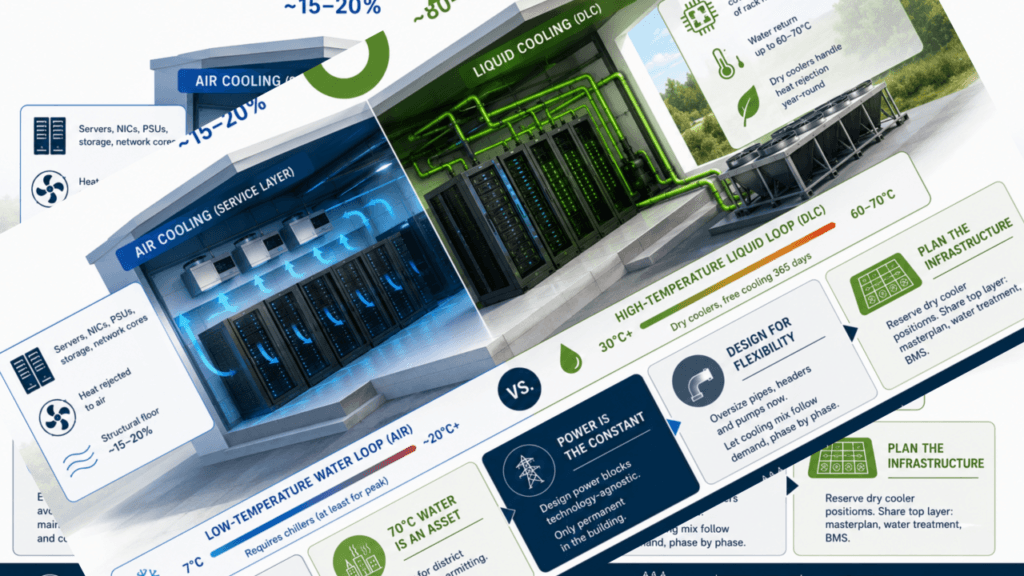
  • Direct-to-chip liquid cooling captures roughly 70–85% of rack heat; memory, NICs, power supplies and optics still reject to air, creating a structural floor of about 15–20% air cooling in any large deployment.
  • Air and liquid are different thermodynamic worlds: the air loop runs on low-temperature water (about 7°C to low-20s°C) and needs chillers; the high-temperature liquid loop returns water at 60–70°C and can reject heat with dry coolers alone, year-round, almost anywhere in Europe.
  • The “chiller tax” is the economic core: chillers carry the highest capex, maintenance, F-gas regulatory exposure and compressor energy – hitting PUE directly. Liquid megawatts do not pay it.
  • At 60–70°C, return water is near-ready district heating supply – in Germany a permitting argument and a potential revenue line under the Energy Efficiency Act.
  • Design conclusion: fix the power blocks, not the cooling ratio. Make power infrastructure technology-agnostic and let the cooling mix follow tenant demand.

Definitions

  • Direct-to-chip (DLC) liquid cooling – cold plates on CPUs/GPUs transfer heat to a liquid loop, removing the majority of rack heat without moving air.
  • Chiller – a compressor-based refrigeration machine producing chilled water for the air-cooling loop; the most expensive element of the chain in capex, maintenance and energy.
  • Dry cooler – a heat exchanger rejecting heat to ambient air without compressors or refrigerants; works alone when loop temperatures are high enough.
  • PUE (Power Usage Effectiveness) – total facility power divided by IT power; compressor energy is one of its biggest drivers.
  • Chiller tax – our shorthand for the combined capex, opex, F-gas exposure and PUE penalty that every air-cooled megawatt carries and liquid-cooled megawatts avoid.

Air vs liquid: the comparison

DimensionAir cooling loopHigh-temp liquid loop (DLC)
Working temperature~7°C to low-20s°C water60–70°C return water
Heat rejectionChillers required (at least for peak trimming)Dry coolers alone, 365 days, virtually anywhere in Europe
Compressors / refrigerantsYes – capex, maintenance, F-gas exposureNone
PUE impactCompressor energy hits PUE directlyMinimal mechanical cooling energy
Share of rack heat (AI hall)Structural floor of ~15–20%~70–85% via direct-to-chip
Heat reuse readinessNeeds heat pump upgrade to be usefulNear district-heating grade as-is
Scaling behaviourShare shrinks as facility growsShare grows with rack density

Why the air share shrinks as facilities scale

When we started planning our new builds we assumed roughly 20% air / 80% liquid. Then we noticed the larger the facility gets, the smaller the air percentage becomes – not by choice, but because physics and economics push it there. Every air-cooled megawatt pays the chiller tax; every liquid megawatt escapes it into dry cooler economics. At scale, that difference compounds.

And yet air never reaches zero. Even in a “fully liquid” AI hall, the residual heat from memory, NICs, power supplies and optics – plus network cores, storage and support infrastructure – lands at about 15–20% air. That is not a design choice. That is physics, at least until chip makers eliminate air-cooled components entirely.

Two loops, not one

One shared water system is not realistic: the loops live at completely different temperatures. What you can share is the top layer – the heat rejection field masterplan, water treatment, and BMS. The hydraulic circuits stay separate.

Waste heat: from cost to revenue

At high-temperature DLC return levels you are sitting on near-ready district heating supply. In Germany, where the Energy Efficiency Act requires heat reuse readiness for large data centers, 60–70°C return water stops being an ESG talking point and becomes a permitting argument – and potentially a revenue line. Lower-temperature loops need a heat pump in between. See the EU Data Centre Regulation Tracker for country-by-country heat reuse rules.

The design conclusion: fix the power blocks

Do not fix the air/liquid ratio in concrete. Design transformers, distribution and UPS topology to be technology-agnostic. Oversize pipes, headers and pump capacity in phase one – cheap now, brutally expensive later – and pre-reserve dry cooler positions in the field masterplan. Then let the cooling mix follow tenant demand, phase by phase. Only one thing in the building is permanent: power.

Frequently asked questions

Can a data center be 100% liquid cooled?

Not today. Direct-to-chip captures 70–85% of rack heat, but memory, power supplies, optics, network and storage still reject heat to air – a structural floor of roughly 15–20% until component design changes.

Does liquid cooling improve PUE?

Yes, primarily by removing compressor energy: high-temperature loops reject heat through dry coolers without chillers, and chiller compressor energy is one of the largest PUE drivers in air-cooled facilities.

Is liquid cooling worth it for existing facilities?

Retrofits are far more expensive than new builds designed for it. The economical path is hybrid: keep the air loop as a service layer and add liquid capacity where rack density demands it – if the pipes and pumps were sized for it in phase one.

Related articles

The Only Constant in a Modern Data Center Is Power

Key takeaways

  • Direct-to-chip liquid cooling captures 70–85% of rack heat; the rest still rejects to air – a structural floor of about 15–20% air in any large deployment.
  • Air and liquid loops run at completely different temperatures (about 7–20°C vs 60–70°C) and cannot realistically share one water system.
  • Every megawatt moved from air to liquid escapes the “chiller tax” – the capex, maintenance, F-gas exposure and PUE penalty of compressor-based cooling.
  • Design conclusion: keep power infrastructure technology-agnostic and let the cooling mix follow tenant demand.

Everything else – especially cooling – is a variable.

Air cooling vs liquid cooling loops in a modern AI data center

When we started planning our new data center builds, we began with what felt like a safe assumption: roughly 20% air cooling, 80% liquid. A reasonable split for an AI-era facility.

Then we noticed something. The larger the facility gets, the smaller the air percentage becomes – not because we decided so, but because the physics and the economics push it there. And yet air never reaches zero. Here’s what we’ve learned designing around that tension.

Air cooling doesn’t disappear – it becomes a service layer.

Even in a “fully liquid” AI hall, direct-to-chip cooling captures roughly 70–85% of rack heat. The rest – memory, NICs, power supplies, optics – still rejects to air. Add network cores, storage, and support infrastructure, and you land at a structural floor of about 15–20% air in any large deployment. That’s not a design choice. That’s physics, at least until chip makers eliminate air-cooled components entirely.

These are two different thermodynamic worlds.

Here’s what gets glossed over in most “hybrid cooling” discussions: air and liquid loops don’t just differ in medium – they live at completely different temperatures.

The air-cooling loop is a low-temperature water system, typically operating anywhere from about 7°C up to the low-20s°C depending on facility design and economization strategy – which means chillers, at least for peak trimming. By contrast, the high-temperature liquid-cooling loop can return water at 60–70°C – and at those temperatures, dry coolers alone handle heat rejection year-round, virtually anywhere in Europe. No compressors. No refrigerants. Free cooling, 365 days.

One shared water system? Not realistically. What you can share is the top layer: the heat rejection field masterplan, water treatment, BMS. The hydraulic circuits themselves stay separate.

Every megawatt you move from air to liquid escapes the chiller tax. This is the economic insight hiding inside the ratio question. Chillers are the most expensive component of the cooling chain – capex, maintenance, F-gas regulatory exposure, and above all compressor energy that hits your PUE directly.

Shift a megawatt from air to liquid, and it doesn’t just change cooling technology. It moves from chiller economics to dry cooler economics. That’s why the air percentage naturally shrinks as facilities scale: every air-cooled megawatt carries a chiller tax that liquid megawatts don’t pay.

70°C return water isn’t waste – it’s an asset. At high-temperature DLC return levels, you’re sitting on near-ready district heating supply. In Germany, where the Energy Efficiency Act already requires heat reuse readiness for large data centers, this stops being an ESG talking point and becomes a permitting argument – and potentially a revenue line. Lower-temperature liquid loops need a heat pump in between; at 60–70°C, you’re much closer to plug-and-play.

So what does this mean for design? Our conclusion: don’t fix the air/liquid ratio in concrete. Fix the power blocks.

Design power infrastructure – transformers, distribution, UPS topology – to be technology-agnostic. Oversize the pipes, headers, and pump capacity in phase one (cheap now, brutally expensive later). Then let the cooling mix follow tenant demand, phase by phase, with dry cooler positions pre-reserved in the field masterplan.

Because in the end, only one thing in the building is permanent: power. Everything downstream of the busbar should be ready to change.

How are you approaching the air/liquid split in your new builds? Curious whether others are seeing the same structural floor around 15–20% air.

#DataCenters #LiquidCooling #AIInfrastructure #Sustainability #DistrictHeating #PUE

https://www.linkedin.com/pulse/only-constant-modern-data-center-power-andris-gailitis-jayrf

Related articles:

Be Among the First: Join the Launch of a Next-Generation AI Data Center in Riga

Key takeaways

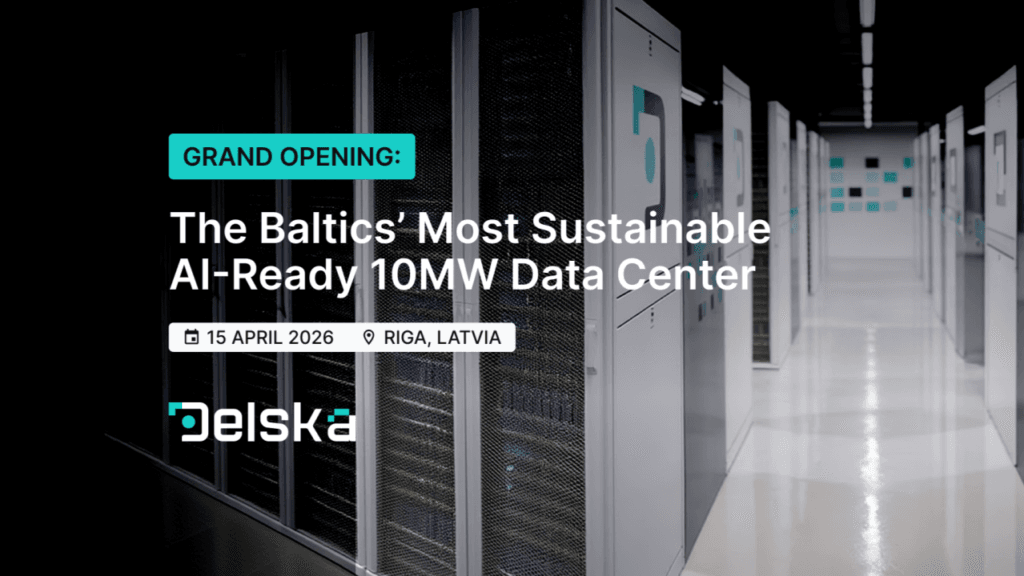
  • Delska EU North Riga LV DC1 – a 10 MW facility expandable to 30 MW, designed for AI, HPC and sovereign digital infrastructure – opened on 15 April 2026 in Riga.
  • Up to 250 kW per rack with hybrid CoolWall air + liquid cooling, powered by 100% renewable energy.
  • Tier III design with 99.982% uptime and a 400G connectivity backbone across Europe.

On April 15, 2026, we will unveil something that goes beyond a traditional data center. We are opening Delska EU North Riga LV DC1 – the most advanced and sustainable data center ever built in the Baltics. A 10 MW facility designed not for today’s workloads, but for what comes next: AI, HPC, and sovereign digital infrastructure in Northern Europe.

Delska EU North Riga LV DC1 - grand opening of the most sustainable AI-ready 10MW data center in the Baltics

This is a strategic milestone not only for Delska, but for the region.

To mark this launch, we are bringing together government representatives, global technology partners, and senior industry leaders to explore the future of compute, energy, and digital sovereignty.

📅 April 15, 2026
📍 Riga, Latvia · In-person & Live Stream (RSVP required)
👉 Register: delska.com/lvdc1-launch-event

EU North Riga LV DC1 is built with a clear promise: infrastructure must scale with ambition.

  • 10 MW capacity, expandable to 30 MW on secured land with reserved power
  • Up to 250 kW per rack to support AI and HPC workloads at scale
  • Hybrid cooling architecture combining CoolWall air and liquid cooling
  • Powered by 100% renewable energy from Northern Europe
  • Designed to Tier III standards with 99.982% uptime
  • 400G connectivity backbone with low-latency access across Europe

This is not just an improved data center. It is a platform for next-generation compute deployment.

The opening will take place in two parts.

Private Opening Ceremony (invitation-only | live streamed) – featuring government leaders and strategic partners, setting the tone for the region’s digital future.

Executive Program (RSVP required) – with contributions from Dell Technologies, Veeam, 11Stream, and Delska, alongside:

  • Forward-looking perspectives on AI infrastructure and sovereign compute
  • Exclusive guided access to the facility
  • High-value networking with the regional and international tech ecosystem

We also have opened reservation access for organizations planning their next phase of infrastructure growth. If you cannot attend our launch event but would like to tour the facility on a private visit, please drop us a message – sales@delska.com.

👉 Pre-book your capacity: delska.com/data-centers/eu-north-riga-lv-dc1

Facilities like this are not built often. And access at this stage is even rarer.

If you are shaping infrastructure strategy for the coming years – this is where the conversation starts. Welcome!

#AIInfrastructure #DataCenters #SovereignCompute #GreenEnergy #Baltics #DigitalTransformation

https://www.linkedin.com/pulse/among-first-join-launch-next-generation-ai-data-center-gailitis-aroof

Related articles:

Data Centres: From Tenants to Titans

Key takeaways

  • The balance of power has flipped: developers and operators, not hyperscalers, now hold the upper hand – the real scarcity is power and land.
  • US data centre rents rose from about $120/kW/month in 2021 to nearly $190 by 2024 – scarcity economics, not inflation.
  • 10-, 15- and 20-year contracts are the norm again, making data centres look and finance like traditional infrastructure.
  • The model is shifting from multi-tenant colocation to single-tenant mega-campuses of hundreds of megawatts.

Five years ago, few imagined that data centres — those humming, power-hungry fortresses of servers — would become one of the most coveted infrastructure assets on the planet.

Data Centres: From Tenants to Titans

But that’s exactly what has happened.

The balance of power has flipped. Once, hyperscalers like AWS, Google, and Microsoft dictated lease terms and pricing. Today, it’s the developers and operators holding the upper hand — because the real scarcity isn’t capital anymore. It’s power and land.


💡 The Golden Ticket

A leading infrastructure investor recently called power access “a golden ticket” — and it’s hard to disagree.

In the age of AI and hyperscale cloud growth, a secured grid connection is everything. You can raise billions and hire world-class engineers — but if you can’t plug into the grid, you can’t scale.

The numbers tell the story. In 2021, U.S. data centre rents averaged around $120 per kW per month. By 2024, that figure climbed over 50%, nearing $190 per kW. London saw similar jumps. This isn’t inflation — it’s scarcity economics.

Those who control powered land now hold the real bargaining power.


🧭 From Hyperscaler Leverage to Developer Control

For years, hyperscalers pushed for short 5- to 7-year contracts and flexible termination rights. They called the shots.

Not anymore.

Tight grid capacity and exploding AI demand have turned the tables. Tenants who once wanted short leases are now regretting it — there’s simply no capacity left, and renewals cost far more.

Today, 10-, 15-, and even 20-year contracts are the norm again. Banks and institutional lenders love it: predictable cash flows, long-dated contracts, and high-credit counterparties. Data centres are starting to look, feel, and finance like traditional infrastructure.


🏗️ From Colocation to Mega-Campuses

The model has evolved dramatically. What used to be multi-tenant colocation sites is becoming a network of massive, single-tenant campuses — hundreds of megawatts each — built around one hyperscaler.

That shift allows developers to recover rising capex costs tied to liquid cooling, AI training, and high-density workloads. Interestingly, many hyperscalers are now co-funding upgrades, treating them as tenant improvements, just like in commercial real estate.

It’s a more mature, symbiotic model — one that aligns incentives and strengthens partnerships.


🤝 Creative Structures and Shared Risk

Deal structures are also becoming more sophisticated.

When Meta financed its $26 billion data centre campus in Louisiana, the project reportedly included a “residual value guarantee.” In other words, if Meta exited early and the asset value dropped, investors would be compensated.

A few years ago, such clauses were rare. Now they’re becoming standard as both sides seek to balance long-term risk and reward.

Developers are also designing hybrid facilities — capable of switching between air and liquid cooling — and adopting flexible layouts that can evolve with technology. As Brookfield’s Sikander Rashid noted, “A chip’s useful life is about five years — your return on capital should match that.”


🏦 Core Capital Enters the Game

Not long ago, core and core-plus funds avoided data centres, seeing them as too technology-driven. That’s changing fast.

Brookfield, Arjun Infrastructure Partners, and Interogo recently invested in a €3.6 billion European data centre portfolio with 12-year average contracts and inflation-linked escalators — exactly the type of structure core infrastructure funds love.

One industry insider summed it up perfectly:

“If you’ve got powered land near population centres, your barrier to entry is the grid connection itself.”

In other words: the moat isn’t a brand or a logo — it’s megawatts.


⚙️ The Moat Built on Megawatts

Every road in this story leads back to power.

If forecasts hold true, most major data centre hubs will hit grid constraints within a decade. That physical bottleneck — not capital — will define value.

It’s why long-term leases are back. It’s why banks are lending more confidently. And it’s why investors view data centres as durable, inflation-protected infrastructure.

Operators like DigitalBridge are also moving to triple-net leases, where tenants manage their own power and cooling systems. That shift drives efficiency and attracts even more institutional capital.


🌍 The Future: Flexible, Long-Term, and Infra-Grade

So, are data centres infrastructure? The debate is over.

They’ve earned their place alongside utilities, ports, and energy assets — long-term contracts, critical grid dependence, and predictable returns.

But beyond the financials lies a bigger truth: the digital economy runs on electrons and geography. Whoever controls the megawatts controls the growth.

AI will only intensify this. The next generation of winners will be those who think like infrastructure investors but move like tech builders — fast, flexible, and focused on power resilience.

The moat is no longer theoretical. It’s physical. It’s grid-connected. And it’s here to stay.


✍️ The digital economy’s backbone isn’t code — it’s concrete, copper, and current. The investors who understand that first will shape the next decade of infrastructure.

Subscribe & Share now if you are building, operating, and investing in the digital infrastructure of tomorrow.

#DataCentres #InfrastructureInvesting #AIInfrastructure #DigitalTransformation #Sustainability #EnergyTransition #RealAssets #PrivateEquity #InfraFunds #Hyperscale #CloudComputing #PowerMarkets #GridCapacity #DataEconomy #LongTermCapital

https://www.linkedin.com/pulse/data-centres-from-tenants-titans-andris-gailitis-qjobf

Related articles:

Beyond Uptime

Key takeaways

  • AI training racks pull 30–80 kW – 5–10x more than the 3–10 kW enterprise racks most pre-2018 facilities were built for.
  • GPU clusters can jump from idle to full draw in a second, stressing both power and cooling systems.
  • Legacy air cooling, UPS and switchgear face hard physical limits with 40+ kW racks.
  • The survivors will not be the newest buildings but the best retrofits: hybrid cooling, modular AI pods and targeted power upgrades.

Can Yesterday’s Data Centers Handle Tomorrow’s AI?

Industry-wide, thousands of megawatts are hostage to data centers that were limiting AI lifecycles before this technology boom. Some are already constructed, some in the middle of construction — all tailored to dirty workloads that still, for most people (until recently), would have looked nothing like today’s GPU-rich cluster.

With the prevalence of high-density AI workloads, hybrid cooling requirements, and one-minute deployment cycles to keep data centers competitive in an AI-driven world, the question becomes extremely relevant.

1. The AI Workload Shift

Artificial Intelligence is changing the rules of infrastructure.

  • At the bottom, we have training clusters — One AI training rack can pull 30–80 KW, which is 5x-10x higher than a traditional enterprise rack.
  • Inference workloads — Not so centralized, but still push physical cooling and networking beyond the realm of legacy architectures.
  • Dynamic loads — GPU clusters can go from idle to full draw in a second, which both stresses power and cooling systems.

For many facilities, this isn’t a “nice to have” upgrade — it’s an existential need to adapt and compete with the next generation of patrons.

2. Limits of Traditional Design

The majority of pre-AI data centers (ones built before 2018, if we were to define it very strictly) were constructed for racks in the 3–10 kW per rack range cooled by air.

  • Cooling: CRAC/CRAH units and hot aisle containment — were not designed for 40+ kW racks.
  • Change-out of UPS, PDUs, and Switchgear sized for lower densities [Selective or Full Replacement]
  • Some unique to the application — 5 kW racks respond better to larger f/r ratios, the circumstances leading up to a raised floor collapse or a rack tipping over because it was back heavy than others (aka top or bottom heavy).

Here though, some facilities are really going to be able to adapt while others may hit hard physical limits that will limit their AI-readiness.

3. Adaptation Strategies

The operators who survive won’t necessarily be the ones with the newest buildings — but those whose retrofits well.

  • A combination of air cooling (for standard workloads) with direct-to-chip liquid cooling or rear-door heat exchangers for AI racks as hybrid cooling models.
  • Modular AI Temps — High-density AI in the rest of the data center once special halls or pods are converted to deter high heat output AI.
  • Point solutions for Power — Enhancing few electric runs to sustain AI loads without turning the facility upside down.
  • Network design — High throughput but best in class low latency interconnects between GPU nodes guaranteeing optimal operation of the cluster.

And Hybridization escapes the ‘all-or-nothing’ syndrome, enabling facilities to tap into AI demand but not at the expense of their current customer base.

4. The Retrofit ROI Question

As a result, not all data centers would — or should — be AI ready.

Retrofitting high-density zones is capex-heavy:

  • That should be up in the millions when it comes to power upgrades.
  • Installing liquid cooling systems requires mechanical, plumbing, and floorplan changes.
  • Network upgrades add further cost.

Workload demand, competitive landscape, and the lifespan of the existing facility constitute your decision point.

In those situations, it may be more cost-effective to create a greenfield site in close proximity to the existing building and visit for scheduled maintenance only rather than investing capital in deep retrofits.

5. The Strategic Outlook

This is the dawn of AI infrastructure expansion. Three likely scenarios are emerging:

  • Traditional racks blended with AI-ready pods: Dual-use facilities
  • Artificial intelligence-specific buildings with layer upon layer of extreme density and liquid cooling built from scratch.
  • AI/ML ‘clusters — rather than metro density, these will concentrate compute closer to large power-rich, low-latency markets.

The AI era doesn’t plan for the next 20-year build cycle. Those operators who change now with clear retrofit strategies in place will secure the first-mover advantage on the next wave of customers.

Closing Thoughts

Actually, running AI is not just “another workload.” It is a completely different thermal, power, and interconnect problem. The form and function of yesterday can meet the AI needs of tomorrow — but only if operators take a targeted, rational, and accelerated approach to redesign.

Subscribe & Share now if you are building, operating, and investing in the digital infrastructure of tomorrow.

AI #DataCenters #AIInfrastructure #HighDensityComputing #HybridCooling #LiquidCooling #GPUClusters #CloudComputing #DataCenterRetrofit #EdgeComputing #DigitalInfrastructure #Colocation #AIThermalManagement #PowerUpgrades #NextGenDataCenters

https://www.linkedin.com/pulse/beyond-uptime-andris-gailitis-hiovf

Related articles:

Proudly powered by WordPress | Theme: Baskerville 2 by Anders Noren.

Up ↑